
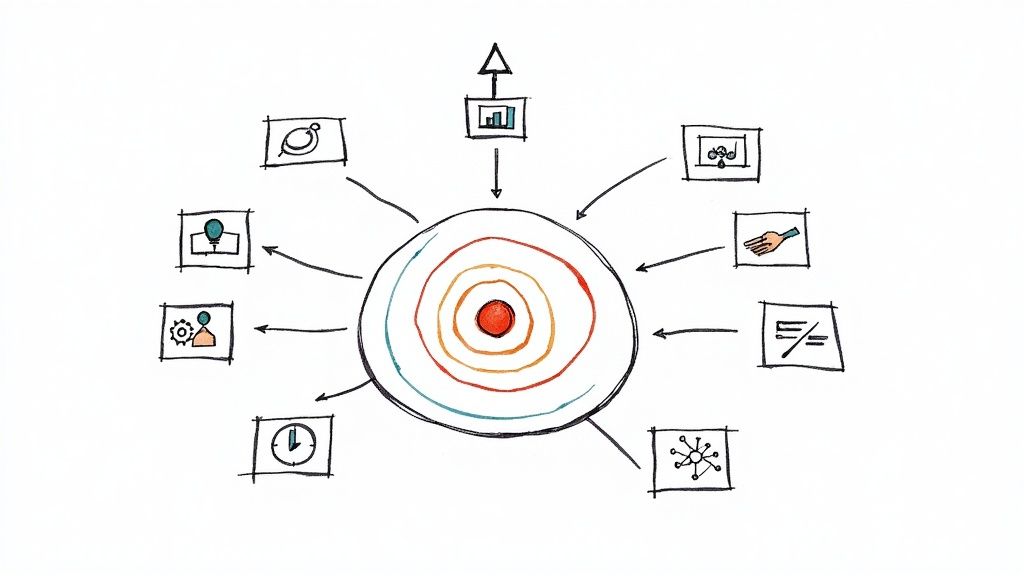
In the competitive landscape of digital marketing, simply running Google Ads campaigns is no longer enough. Your business's ability to attract, convert, and retain high-value customers depends on a systematic approach to optimizing every facet of your advertising efforts. This is where Google Ads best practices come in. They are the strategic bridge connecting your marketing budget with your business results, transforming ad spend into measurable revenue.
Effective Google Ads management is not just about having a high click-through rate (CTR) or a few good keywords. It is the process of providing your campaigns with the right structure, targeting, creative, and analytics they need to engage prospects and drive conversions efficiently. For any business using Google Ads, this means equipping your campaigns to articulate the complex value of your products or services, from advanced bidding strategies to landing page optimization, in a way that resonates with a customer's needs.
This guide moves beyond generic advice and dives into 10 critical Google Ads best practices tailored specifically for modern advertisers. Each point is designed to be immediately actionable, helping you refine your campaign structure, from managing keyword match types to implementing powerful conversion tracking.
You will learn how to:
- Align your account structure with your business goals for cohesive messaging.
- Develop targeted ad copy and assets that address specific customer pain points.
- Integrate the right technology and automation to streamline workflows and boost productivity.
- Use data and analytics to optimize your campaigns for peak performance.
By implementing these strategies, you ensure your campaigns are fully equipped not just to generate clicks, but to demonstrate an undeniable impact on your business's growth. Let's get started.
1. Mastering Keyword Research and Match Types
For any Google Ads campaign, effective advertising begins with a well-organized and strategic approach to keywords. This practice involves creating a centralized and logical structure for all the search terms your potential customers use. It moves beyond a messy, broad-match-only strategy into a system where every keyword is purposeful, relevant, and assigned the correct match type to control traffic quality.
A robust keyword strategy ensures your ads are shown to the most relevant audience. By using a mix of broad, phrase, and exact match types, you can control how closely a user's search query must match your keyword to trigger an ad. This immediate control over your audience validates your campaign's relevance at every touchpoint, from the initial search to the final conversion. It’s a foundational element of our Google Ads best practices because it directly impacts click-through rate (CTR) and conversion rates.

Why It's a Top Practice
A centralized and well-managed keyword list empowers your campaigns with precision and efficiency. When a user in the legal industry searches for a specific service, your ad appears because you’ve targeted a precise phrase match keyword. You avoid wasting budget on irrelevant searches, shortening the path to conversion and building immediate trust. According to recent data, advertisers see an average of a 2% click-through rate (CTR) on Google Search, but highly relevant keywords can push this figure to 5% or more.
Key Insight: Your keywords are a direct reflection of your customer understanding. Disorganized, overly broad, or irrelevant keywords undermine your credibility and waste your budget before a user even sees your landing page.
Actionable Implementation Steps
- Use the Keyword Planner: Start with Google’s own Keyword Planner to discover new keywords, get search volume data, and see cost estimates.
- Structure with SKAGs (Single Keyword Ad Groups): For your most important keywords, create ad groups that contain only one keyword. This allows you to write hyper-relevant ad copy that matches the search term exactly, boosting your Quality Score.
- Implement a Negative Keyword Strategy: Schedule weekly or bi-weekly reviews of your Search Terms Report. Add irrelevant search queries as negative keywords to prevent wasted spend on unqualified clicks.
- Test Match Types: Start with a combination. Use broad match with Smart Bidding to discover new queries, but use phrase and exact match for your core, high-intent keywords to maintain control and relevance.
2. Implementing Rigorous A/B Testing and Optimization
In the Google Ads ecosystem, scaling success is impossible without a systematic approach to testing. This practice involves building a structured testing schedule for your ad copy, landing pages, and targeting settings. It goes beyond a quick headline change and dives deep into a methodical process of hypothesis, implementation, and analysis to find what truly resonates with your audience.
A well-designed testing program ensures every element of your campaign is continuously improving. You learn not just what a Responsive Search Ad is, but which combination of headlines and descriptions drives the highest conversion rate for a specific audience. This structured learning is one of the most critical Google Ads best practices because it directly reduces your cost-per-acquisition (CPA) and boosts overall campaign return on investment (ROI) by standardizing excellence.
Why It's a Top Practice
Structured testing eliminates the guesswork in your optimization process. When you see a low conversion rate, a trained advertiser can launch a landing page A/B test with a clear hypothesis, providing a data-driven answer that improves performance. This consistency builds a stronger campaign over time and positions your business as an expert in understanding customer needs. Google's own data shows that businesses using A/B testing on landing pages can see conversion rate increases of 30-40%.
Key Insight: Without formal testing, you default to assumptions, leading to inconsistent messaging, a higher CPA, and a brand image that is fragmented and unpredictable.
Actionable Implementation Steps
- Build a Testing Roadmap: Create a 30-60-90 day plan for your tests. The first 30 days should focus on high-impact elements like ad headlines and calls-to-action. The next 60 days should involve landing page variations, with the final 30 days focused on testing bidding strategies.
- Use Experiments for Major Changes: Use the "Experiments" feature within Google Ads for significant tests, such as comparing a Target CPA bidding strategy against a Maximize Conversions strategy. This allows you to test changes on a portion of your traffic without risking the entire campaign's performance.
- Adopt a "One Variable at a Time" Rule: To get clean data, only change one element at a time in your A/B tests. If you change both the headline and the landing page, you won't know which one was responsible for the change in performance.
- Track ROI with Key Metrics: Measure the impact of your tests by tracking key KPIs. Monitor conversion rate, cost-per-conversion, and ROAS before and after implementing winning variations from your tests.
3. Integrating Your Google Ads Tech Stack
A powerful Google Ads strategy is built on a foundation of technology that works together seamlessly. This involves more than just having a Google Ads account; it means strategically selecting and integrating tools that automate tasks, provide data-driven insights, and empower you to focus on high-value strategic work. A well-integrated tech stack eliminates data silos and connects every stage of the customer journey, from ad click to final sale.
For an e-commerce business, this could mean your CRM (like Salesforce) automatically pulls conversion data from Google Ads, enriching customer profiles with real-time campaign metrics. When a customer makes a purchase, that data is sent back to Google Ads to optimize for similar high-value customers. Integrating these tools is a cornerstone of modern Google Ads best practices because it transforms raw data into actionable advertising intelligence.

Why It's a Top Practice
An integrated tech stack reduces friction and eliminates time-wasting manual tasks. Instead of manually uploading conversion data or trying to match leads to campaigns, you can rely on automation to handle the data flow. This allows you to spend more time analyzing performance and developing creative strategies, directly accelerating campaign optimization and improving your ROAS.
Key Insight: Your technology stack should be a force multiplier for your advertising efforts, not a series of disconnected administrative hurdles. The goal of integration is to make the right data available at the right time.
Actionable Implementation Steps
- Prioritize the Core Systems: Start by ensuring your Google Ads account, Google Analytics 4, and CRM are seamlessly connected. This forms the central nervous system of your marketing operations.
- Automate Data Entry with Offline Conversion Tracking: Use native integrations or API-driven tools to connect your platforms. For instance, you can learn more about using webhooks for Google Ads integration to automatically pass lead data from your forms directly into your CRM, and then send qualified lead data back to Google Ads as conversions.
- Set Up Enhanced Conversions: Implement Enhanced Conversions to send first-party, hashed customer data from your website to Google. This improves the accuracy of your conversion measurement, especially in a world with fewer cookies.
- Audit Usage and Consolidate: Regularly review which platforms are being used and which are redundant. Paying for multiple analytics tools with overlapping features is a common and costly mistake. Eliminate unused software to streamline your stack and budget.
4. Leveraging Smart Bidding and Performance Management
Effective Google Ads management isn't a "set it and forget it" activity; it's a continuous process of refinement. This is where dedicated performance management, powered by Google's Smart Bidding, comes in. This practice involves establishing regular, data-driven feedback loops to help the algorithm improve your campaign performance in real time. It shifts the focus from manually adjusting bids to developing the specific strategies that lead to sustained success.
For a lead generation business, this means moving beyond just tracking form fills. Instead, you use offline conversion tracking to tell Google which leads turned into actual customers. The algorithm then uses signals from those high-quality conversions to find more people like them. This commitment to data quality is one of the most impactful Google Ads best practices because it directly enhances the quality of every click and conversion.
Why It's a Top Practice
Consistent performance management builds a culture of excellence and adaptability. When a campaign is struggling to hit its Target CPA, a targeted analysis of the auction insights report can provide concrete, actionable feedback. This process turns a single underperforming week into a valuable learning opportunity, equipping you to adjust budgets or creative more effectively in the future and directly improving your ROI.
Key Insight: Top-performing Google Ads accounts aren't just built, they are developed. Investing in high-quality data for Smart Bidding provides a far greater ROI than constantly tweaking manual bids, as it builds a powerful learning loop.
Actionable Implementation Steps
- Implement Accurate Conversion Tracking: Ensure your conversion tracking is flawless. Use the Google Tag and GA4 to track every valuable action, from form submissions to phone calls and purchases.
- Choose the Right Bidding Strategy: Align your bidding strategy with your business goals. Use "Maximize Conversions" if your goal is volume, "Target CPA" if you have a strict cost-per-lead goal, and "Target ROAS" for e-commerce.
- Feed the Algorithm High-Quality Data: Use value-based bidding by assigning different values to different conversions. A "demo request" lead is more valuable than a "newsletter signup," and your bidding should reflect that.
- Use Performance Planner: Use the Performance Planner tool to forecast how changes to your budget and bidding targets will impact performance. This allows you to plan your media spend more strategically.
5. Implementing a Full-Funnel Advertising Strategy
For most businesses, success with Google Ads shifts the focus from chasing a high volume of bottom-funnel clicks to strategically engaging users at every stage of the customer journey. This practice involves deep collaboration between different campaign types to treat the entire funnel as a single market. It’s about precision, personalization, and coordinated multi-channel outreach to attract and nurture valuable customers.
Instead of only running Search campaigns aimed at someone searching "buy running shoes," a full-funnel approach involves using YouTube Ads to build brand awareness and Display remarketing to re-engage users who visited your site but didn't purchase. This alignment is a cornerstone of advanced Google Ads best practices because it maximizes resource efficiency and targets customers with the highest lifetime value potential.
Why It's a Top Practice
Aligning campaign types on a full-funnel strategy eliminates wasted effort and missed opportunities. When a user is in the awareness stage, a captivating YouTube ad can introduce them to your brand. Later, when they are actively searching, your Search ad appears, now with the added benefit of brand recognition. This coordinated approach warms up the audience, making your bottom-funnel ads far more effective and improving overall campaign efficiency.
Key Insight: A full-funnel strategy isn't just for large brands; it's a scalable framework. It ensures your most expensive clicks—those on high-intent search terms—are supported by cheaper, awareness-building activities that increase their effectiveness.
Actionable Implementation Steps
- Define Your Funnel Stages: Clearly map out what the awareness, consideration, and conversion stages look like for your customers.
- Create Audiences for Each Stage: Use Google Analytics 4 to build audiences based on user behavior. For example, create an "all website visitors" audience for remarketing and a "cart abandoners" audience for a more aggressive offer.
- Develop Stage-Specific Creative: Your ad copy and creative should match the funnel stage. Awareness ads on YouTube should be engaging and tell a story. Conversion ads on Search should be direct and feature a clear call-to-action.
- Establish a Remarketing Strategy: Mandate that every campaign has a corresponding remarketing list. Use Display, YouTube, and RLSA (Remarketing Lists for Search Ads) to stay top-of-mind with users who have already shown interest.
6. Utilizing Audience Signals and Analytics
Audience intelligence is the practice of using Google's powerful tools to understand and target specific groups of users. For any advertiser, this means gaining deep, data-driven insights from every campaign to discover what truly resonates with your most valuable customers. These platforms move beyond simple demographics by identifying in-market audiences, affinity segments, and even your own customer data to reveal your ideal user profile.
By analyzing which audiences have the highest conversion rates, you can build a library of proven targeting segments. This technology transforms subjective feedback into objective data, showing you precisely which user attributes, interests, and behaviors are most predictive of success. This makes it a crucial part of any modern Google Ads best practices framework, as it provides a direct feedback loop from the market to your targeting strategy.

Why It's a Top Practice
Audience intelligence provides a scalable way to find new customers and refine your targeting. Instead of relying on keywords alone, you can discover that your best customers are often in the "in-market for business services" audience segment. This allows you to create targeted campaigns on Display or YouTube to proactively reach these users before they even search for your solution, directly improving your campaign's effectiveness.
Key Insight: The answers to finding more customers are already present in your campaign data. Google's audience tools simply give you the ability to find and act on those insights at scale.
Actionable Implementation Steps
- Start with Observation Mode: Add relevant in-market and affinity audiences to your Search campaigns in "Observation" mode. This allows you to gather data on how these audiences perform without restricting your campaign's reach. You can then apply positive bid adjustments to top-performing segments.
- Use Your Own Data with Customer Match: Upload your customer email or phone lists to create Customer Match audiences. You can target these users directly, exclude them from prospecting campaigns, or create similar audiences to find new people with shared characteristics.
- Integrate GA4 Audience Insights: Use the powerful audience builder in Google Analytics 4 to create highly specific segments, such as "users who have made 3+ purchases" or "users who have visited a key page but not converted."
- Provide Audience Signals for Performance Max: When using Performance Max, provide high-quality audience signals (like Customer Match lists and custom segments) to help the algorithm learn faster and find the right customers for your business.
7. Optimizing for Mobile and Device Performance
Adopting a mobile-first optimization strategy provides a structured, repeatable playbook for capturing the modern consumer. This practice moves beyond simply having a responsive website, establishing a consistent approach for creating mobile-specific ads, optimizing landing pages for speed, and analyzing performance across devices. It’s about creating a shared process that ensures a seamless user experience from a mobile ad click to a mobile conversion.
Implementing a framework like creating mobile-specific ad copy or using mobile-preferred ad assets ensures that every user gets an experience tailored to their device. Instead of just running the same ads on desktop and mobile, you learn to craft concise, powerful messages for smaller screens and prioritize call extensions for easy click-to-call functionality. This structured approach is a core component of Google Ads best practices because it makes your performance on this critical segment predictable and scalable. Over 60% of Google searches now happen on mobile devices.
Why It's a Top Practice
A unified device strategy ensures every potential customer receives a consistent and high-quality experience, regardless of which device they use. When a user on their phone sees a slow-loading, desktop-optimized page after clicking your ad, they are highly likely to bounce. A team trained in mobile optimization will consistently check PageSpeed Insights and ensure the mobile user journey is frictionless, preventing lost conversions and reinforcing your brand's credibility.
Key Insight: A poor mobile experience isn't just an inconvenience; it's a direct signal to Google that your page is low quality, which can harm your Ad Rank and increase your costs.
Actionable Implementation Steps
- Analyze the Device Performance Report: Regularly check the device report in Google Ads to see how your campaigns perform on mobile, desktop, and tablet. Use this data to apply device-specific bid adjustments.
- Optimize for Page Speed: Use Google's PageSpeed Insights tool to test your landing pages' mobile loading speed. A one-second delay in mobile load times can impact conversion rates by up to 20%.
- Create Mobile-First Creative: Use Responsive Search Ads to write shorter headlines and descriptions that won't get truncated on mobile screens. For Display and YouTube, ensure your branding is clear and visible even on a small screen.
- Leverage Mobile-Specific Ad Assets: Prioritize mobile-friendly assets (formerly extensions) like call extensions and location extensions, which make it easy for users to take action directly from the search results page.
8. Utilizing Ad Assets to Maximize CTR
For any Google Ads advertiser, effective campaign management goes beyond your ad copy; it involves deeply understanding and utilizing the full suite of Ad Assets (formerly Ad Extensions). This practice involves systematically adding, testing, and optimizing assets to provide users with more information and more reasons to click on your ad. It’s about arming your campaigns not just with a great headline, but with sitelinks, image assets, and structured snippets that make your ad stand out.
A robust asset strategy provides data on which links, images, and promotions resonate most with users. This allows your campaigns to move beyond generic ads and instead deliver rich, informative search results like, "Official Site – Shop Our Summer Sale. Free Shipping On All Orders. View Our 5-Star Reviews." This targeted approach is a core component of Google Ads best practices, as it transforms standard text ads into powerful, conversion-driving placements.
Why It's a Top Practice
Using Ad Assets gives your campaigns a significant competitive advantage. They increase the physical size of your ad on the search results page, pushing competitors down and improving your visibility. For instance, Google reports that adding sitelinks can increase an ad's click-through rate (CTR) by an average of 10-15%.
Key Insight: Not using Ad Assets is like paying for a full-page magazine ad and only using a quarter of the space. They are a free way to improve performance.
Actionable Implementation Steps
- Implement Foundational Assets: At a minimum, every campaign should have Sitelinks, Callouts, and Structured Snippets. These provide essential information and take only minutes to set up.
- Test Image and Lead Form Assets: For eligible accounts, test Image Assets to add a visual component to your search ads. For lead generation, experiment with Lead Form Assets to capture user information directly from the search results page.
- Develop Campaign-Specific Assets: For a sales campaign, use Promotion Assets to highlight a discount. For a branding campaign, use Sitelinks that direct to "About Us" or "Case Studies" pages.
- Review Asset Performance: Don't just set and forget them. Regularly check the "Assets" report in Google Ads to see the click-through rate and conversion data for each asset. Pause underperforming assets and test new variations.
9. Structuring Campaigns for Success (Smarketing Alignment)
True Google Ads success happens when your campaigns operate as a single, cohesive unit with your overall marketing strategy. This practice, often called "smarketing" alignment, involves breaking down campaign silos to create a unified structure with shared goals, metrics, and messaging. It ensures the high-intent traffic generated by your Search campaigns is supported by the awareness and remarketing efforts of your Display and YouTube campaigns.
When your brand awareness campaigns on YouTube are designed to warm up the audiences that your Search campaigns will later target, you can optimize the entire funnel for revenue, not just clicks or leads. This alignment is a cornerstone of modern Google Ads best practices because it directly connects top-of-funnel spend to bottom-funnel outcomes, creating a powerful feedback loop that fuels sustainable growth for your business.
Why It's a Top Practice
Misalignment is incredibly costly. A Search team might celebrate a high click-through rate, while the business struggles because those users have no prior brand knowledge and don't convert. A smarketing approach closes this gap. The brand team learns from the Search team what pain points users have, allowing them to create targeted YouTube ads and Display creative that pre-qualify audiences and address concerns upfront.
Key Insight: Without alignment, your brand campaigns are optimizing for vanity metrics (like view rate) while your performance campaigns are left with cold, expensive traffic. A unified structure forces all campaigns to focus on the only metric that matters: revenue.
Actionable Implementation Steps
- Structure by Business Goal: Create campaigns based on your business objectives. Have separate campaigns for "Brand Awareness," "Lead Generation," and "E-commerce Sales."
- Establish Shared Audiences: Use GA4 to create core audiences (e.g., "all visitors," "converters") that are shared and used across all campaign types for targeting and exclusion.
- Hold Joint Performance Reviews: When reviewing performance, bring data from all campaign types together. Analyze how a spike in YouTube views impacted branded search volume and conversion rates. Use attribution reports to understand the full customer journey.
- Implement a Data Feedback Loop: Use Customer Match and Offline Conversion Tracking to create a formal process for feeding sales data back into Google Ads. This gives brand campaigns real data on which audiences are ultimately driving revenue.
10. Using Competitive Analysis and Auction Insights
Arming your Google Ads strategy with competitive intelligence is a critical yet often overlooked practice. This involves creating a clear understanding of your key competitors and systematically analyzing your performance against them using the Auction Insights report. This isn't just about knowing competitor names; it's about understanding their ad copy, landing pages, and share of voice, and how to position your business's unique value proposition against them.
The Auction Insights report provides you with data on impression share, overlap rate, and outranking share. When combined with rigorous analysis of competitor ads, it creates a powerful feedback loop. You learn precisely why you win auctions (e.g., your higher Quality Score) and why you lose them (e.g., a competitor's more aggressive bidding). This continuous learning is one of the most impactful Google Ads best practices for staying ahead in a crowded market.
Why It's a Top Practice
In the competitive Google Ads space, users are always evaluating multiple options. Auction Insights equips you to confidently navigate a crowded search results page and reframe your strategy around your strengths. When a competitor suddenly increases their impression share, you can use the report to diagnose the issue and pivot to a different set of keywords or adjust your bidding strategy to defend your position.
Key Insight: Without formal competitive intelligence, your campaign strategy is developed in a vacuum, leading to missed opportunities and lost market share. A structured analysis of auction data turns every search into a strategic lesson.
Actionable Implementation Steps
- Schedule Weekly Auction Insights Reviews: For each major campaign, schedule a brief weekly review of the Auction Insights report. Look for new competitors entering the auction and significant changes in impression share from existing competitors.
- Focus on Client Value in Ad Copy: Analyze competitor ads by searching for your top keywords in incognito mode. Frame your differentiators around client benefits. Don't say "We are certified"; say "Our Certified Experts Deliver a 20% Higher ROAS on Average."
- Conduct Structured Landing Page Reviews: Analyze the landing pages of your top 3 competitors. Ask yourself, "What is their primary call-to-action? What social proof are they using? Is their user experience better than ours?"
- Segment by Device and Time: Use the segmentation options in the Auction Insights report. You may find that certain competitors are much more aggressive on mobile devices or only during business hours. Use this data to refine your own bidding strategy.
10-Point Google Ads Best Practices Comparison
| Capability | Implementation Complexity 🔄 | Resource Requirements ⚡ | Expected Outcomes 📊 | Ideal Use Cases 💡 | Key Advantages ⭐ |
|---|---|---|---|---|---|
| Keyword Research and Management | Medium — initial research and structuring; continuous upkeep 🔄 | Keyword tools, analytics, time for review; moderate cost ⚡ | Higher CTR, better Quality Score, ↑conversion rate 📊 ⭐⭐⭐ | All Search campaigns, lead generation, e-commerce | Traffic quality control; cost efficiency; high relevance ⭐ |
| A/B Testing and Optimization | High — hypothesis design, implementation, analysis 🔄🔄 | Testing tools, landing page software, analyst time; high effort ⚡⚡ | Reduced CPA, higher conversion rates, measurable ROI impact 📊 ⭐⭐⭐⭐ | High-traffic campaigns, landing page optimization, ad copy improvement | Data-driven decisions; continuous improvement; higher ROAS ⭐ |
| Tech Stack Integration | Very high — API connections, data models, governance 🔄🔄🔄 | CRM, analytics platforms, developer time; high ongoing cost ⚡⚡⚡ | Accurate attribution, automation, improved Smart Bidding; higher LTV 📊 ⭐⭐⭐⭐ | Lead gen businesses, e-commerce with offline sales, data-driven marketing | Eliminates manual work; centralizes insights; automates workflows ⭐ |
| Smart Bidding and Performance Management | Medium-high — data integrity setup and strategy selection 🔄🔄 | Accurate conversion tracking, analytics, strategic oversight; moderate cost ⚡⚡ | Lower CPA, higher ROAS (≈15-20% lift on average), improved efficiency 📊 ⭐⭐⭐ | Campaigns with sufficient conversion data (15+/month) | Real-time optimization; auction-time bidding; scales easily ⭐ |
| Full-Funnel Advertising Strategy | High — cross-channel planning and audience management 🔄🔄 | Creative assets, multiple campaign types, analytics; high effort ⚡⚡ | Larger audience pool, improved brand recall, lower blended CPA 📊 ⭐⭐⭐⭐ | Brand building, long sales cycles, market expansion | Highly coordinated messaging; nurtures leads; better ROI ⭐ |
| Audience Signals and Analytics | Medium — audience setup, data analysis 🔄🔄 | Google Analytics, Customer lists, analyst/strategist time; subscription cost ⚡⚡ | Better targeting, new customer discovery, ↑conversion rates (≈10-15%) 📊 ⭐⭐⭐ | Performance Max, Display/YouTube campaigns, market segmentation | Data-driven targeting, improved personalization, scalable audience discovery ⭐ |
| Mobile and Device Optimization | Medium — responsive design, page speed checks, bid adjustments 🔄🔄 | Developer time, mobile-first design, analytics; moderate cost ⚡ | Better mobile conversion rates, lower mobile CPA, improved user experience 📊 ⭐⭐⭐ | All businesses with mobile traffic, local services, e-commerce | Capture mobile majority; improved Ad Rank; better UX ⭐ |
| Ad Asset (Extension) Optimization | Low — initial setup and regular review 🔄 | Copywriting, image assets, time for maintenance; low cost ⚡ | Higher CTR (≈10-15%), improved Ad Rank, more ad real estate 📊 ⭐⭐⭐ | All Search campaigns, especially in competitive markets | Free performance boost; increased visibility; more user info ⭐ |
| Campaign Structure and Smarketing | High — cultural change, shared goals, joint planning 🔄🔄🔄 | Governance, joint processes, integrated tech, regular meetings; medium cost ⚡⚡ | Higher ROAS and retention, better traffic quality and forecasting 📊 ⭐⭐⭐⭐ | Businesses with multiple marketing channels and teams | Shared metrics, smoother customer journey, improved marketing ROI ⭐ |
| Competitive and Auction Insights Analysis | Medium — research cadence and data interpretation 🔄🔄 | Analysts, time for review, third-party tools; ongoing maintenance ⚡ | Improved impression share, refined messaging, strategic advantage 📊 ⭐⭐⭐ | Highly competitive markets, frequent competitor shifts | Defend market share; evidence-based differentiation; strategy refinement ⭐ |
Turning Best Practices into Business Growth
Navigating the competitive landscape of Google Ads requires more than just technical expertise; it demands a sophisticated and data-driven strategy. Throughout this guide, we've explored ten critical Google Ads best practices that can transform your account from a simple traffic driver into a strategic growth engine for your business. We've moved beyond surface-level advice to provide a blueprint for building a high-performance advertising machine, grounded in actionable strategies and measurable results.
The journey starts with arming your campaigns with the right foundation. From meticulous Keyword Research and Management that delivers the most relevant traffic, to a fully integrated Technology Stack, you lay the groundwork for efficiency. But a good foundation is only as good as the structure built upon it. This is where robust A/B Testing and continuous Smart Bidding Management become non-negotiable, ensuring every element of your account is optimized for performance.
From Process to Predictable Revenue
Adopting a structured approach is the key to unlocking consistent growth. Implementing a clear Campaign Structure, aligned with your full marketing funnel, provides a shared language and a proven roadmap to guide users from awareness to conversion. When you combine this with the targeted precision of Audience Signals and tight Mobile Optimization, you stop casting a wide, inefficient net and start focusing your resources on high-value users who are most likely to convert and grow.
This strategic focus is sharpened by data. By leveraging Auction Insights, you can dissect what top competitors are doing differently and find opportunities to win. Similarly, developing rich ads with Ad Assets and conducting rigorous Performance Analysis replaces guesswork with strategic insight, preparing your campaigns to counter objections and highlight your unique advantages in the Google ecosystem. The final piece of this puzzle is a deep, empathetic understanding of your customers, powered by robust Analytics that reveal their true pain points and goals.
Your Business's Next Steps in Google Ads
Mastering these Google Ads best practices is not a destination; it's a continuous commitment to excellence and adaptation. It's the difference between merely buying clicks and forging long-term customer relationships built on trust and tangible results. An effective advertising strategy empowers you to have more meaningful interactions, close more sales, and ultimately, drive predictable, scalable revenue for your business. Don't view this as a massive, all-or-nothing overhaul. The most successful advertisers begin with a focused approach.
Here’s a simple, actionable plan to get started:
- Conduct a quick audit: Review the ten practices we've covered and identify the single biggest bottleneck in your current campaigns. Is it a lack of relevant keywords? A poor mobile experience? Or a knowledge gap about your top competitors?
- Choose one area to master: Select the one practice that will deliver the most immediate impact. If your campaigns struggle with low CTR, start with Ad Assets and A/B testing ad copy. If your CPA is too high, focus on conversion tracking and Smart Bidding.
- Define clear KPIs and a timeline: Set a realistic goal for the next 90 days. For example, "Increase our mobile conversion rate by 15% by implementing landing page speed improvements and mobile-specific ad copy."
- Iterate and expand: Once you’ve made measurable progress in one area, move to the next. This incremental, systematic approach builds momentum and ensures that each new initiative is built on a solid foundation.
By embracing this strategic framework, you are not just improving your Google Ads account; you are building a resilient, adaptable business poised for sustained growth in the ever-evolving world of digital marketing.
Ready to supercharge your lead management and bridge the gap between marketing and sales? Pushmylead automates the lead forwarding process, ensuring your sales team receives high-quality, actionable leads from your Google Ads campaigns in real-time. Integrate your entire sales enablement stack and eliminate manual lead entry for good at Pushmylead.