

It's a persistent threat in the Google Ads ecosystem, a direct assault on your campaign budget. Click farms deploy real people to unleash a torrent of fraudulent clicks, draining your ad spend without a single genuine conversion in sight. This isn't just a minor issue; it's a sophisticated operation designed to undermine your entire advertising strategy.
These operations are often hired by competitors to exhaust your budget or by dishonest publishers on the Google Display Network looking to inflate their earnings. Either way, you're left with a depleted budget, corrupted campaign data, and lost opportunities to connect with real customers who are actively searching for your services.
How Click Farms Poison Your Google Ads Ecosystem
Imagine a competitor paying dozens of people to enter your physical store, fill a shopping cart, and abandon it at the checkout all day long. The store looks busy, but your revenue is zero. That’s precisely what a click farm does to your Google Ads campaigns.
At its core, a click farm is an organized enterprise that pays low-wage workers to manually click on ads. Unlike automated bots that follow simple scripts, this is human-powered fraud executed across thousands of unique devices—smartphones, tablets, and desktops. This use of real devices and human interaction makes the activity incredibly difficult for automated systems to distinguish from legitimate user interest.
Why Do They Do It? The Two Primary Motives
To build a robust defense within the Google Ads platform, you must first understand the motives driving these attacks. A click farm attack on your Google Ads almost always stems from one of two goals:
-
Competitor Sabotage: A rival business pays a click farm to bombard your ads with clicks. The objective is simple and ruthless: exhaust your daily budget with worthless traffic. Once your budget cap is hit, your ads are pulled from the auction for the rest of the day, leaving a clear field for their ads to be shown to actual customers.
-
Publisher Fraud: Some website owners or app developers participating in the Google Display Network (GDN) use click farms to artificially inflate clicks on the ads hosted on their properties. Since they earn a percentage of the ad revenue for each click, they are essentially faking engagement to steal your advertising budget.
A 2024 ad fraud report revealed that global losses from fraudulent activity have surged to $37.7 billion, with projections indicating further growth. A significant portion of this damage is attributed to sophisticated operations like click farms, which often combine human clickers with bots to evade detection.
The Ripple Effect: More Than Just Wasted Spend
The damage from a click farm attack extends far beyond the immediate financial loss. It triggers a negative chain reaction that can derail your entire marketing strategy and corrupt Google's own optimization systems.
All of that fake engagement sends misleading signals to Google's machine learning algorithms. The system observes a sky-high click-through rate (CTR) and mistakenly concludes your ad is highly relevant and successful. As a result, it begins to allocate more of your budget to show the ad to the same fraudulent audiences, deepening the financial drain.
This skews your performance data so severely that making informed optimization decisions becomes impossible. You might start allocating more budget to campaigns that appear successful but are actually riddled with fraud, chasing phantom metrics instead of engaging with a real, valuable audience.
The True Financial Cost of Click Fraud on Your Ad Spend
Click farm fraud isn't a minor line item; it's a direct hemorrhage of your campaign's ROI. A significant portion of your daily Google Ads budget can leak out before a real customer ever sees your ad. This isn't about a few accidental clicks; it's a systematic drain that reduces the capital available to reach your target audience.
This constant stream of invalid clicks depletes your budget, often exhausting it before your peak business hours. The result? Your campaign reports indicate the daily budget was spent, but your lead and sales numbers remain flat. You are left with skewed analytics and a significant number of missed opportunities to connect with genuine prospects.
High-Stakes Industries Are Prime Targets
The problem is amplified in industries with a high cost per click (CPC). For a fraudster, a high CPC translates to a larger, faster payout from a smaller number of clicks. This economic incentive makes highly competitive sectors magnets for click farm operations.
Industries that are particularly vulnerable include:
- Legal Services: With keywords for practice areas like personal injury costing over $100 per click, a competitor can inflict significant financial damage and knock a rival out of the ad auction with just a handful of fraudulent clicks.
- Finance and Insurance: High-value keywords for mortgages, loans, and insurance policies make these sectors prime targets for budget-draining attacks.
- Home Services: Competitive local markets for plumbers, HVAC technicians, and restoration specialists often feature expensive keywords, making them susceptible to both competitor sabotage and publisher fraud.
For businesses in these markets, a click farm attack represents a substantial loss of potential revenue each day. The high financial stakes create a powerful and persistent incentive for fraudsters to target them.
The infographic below illustrates the two primary methods used by click farms, both resulting in direct financial losses for advertisers.
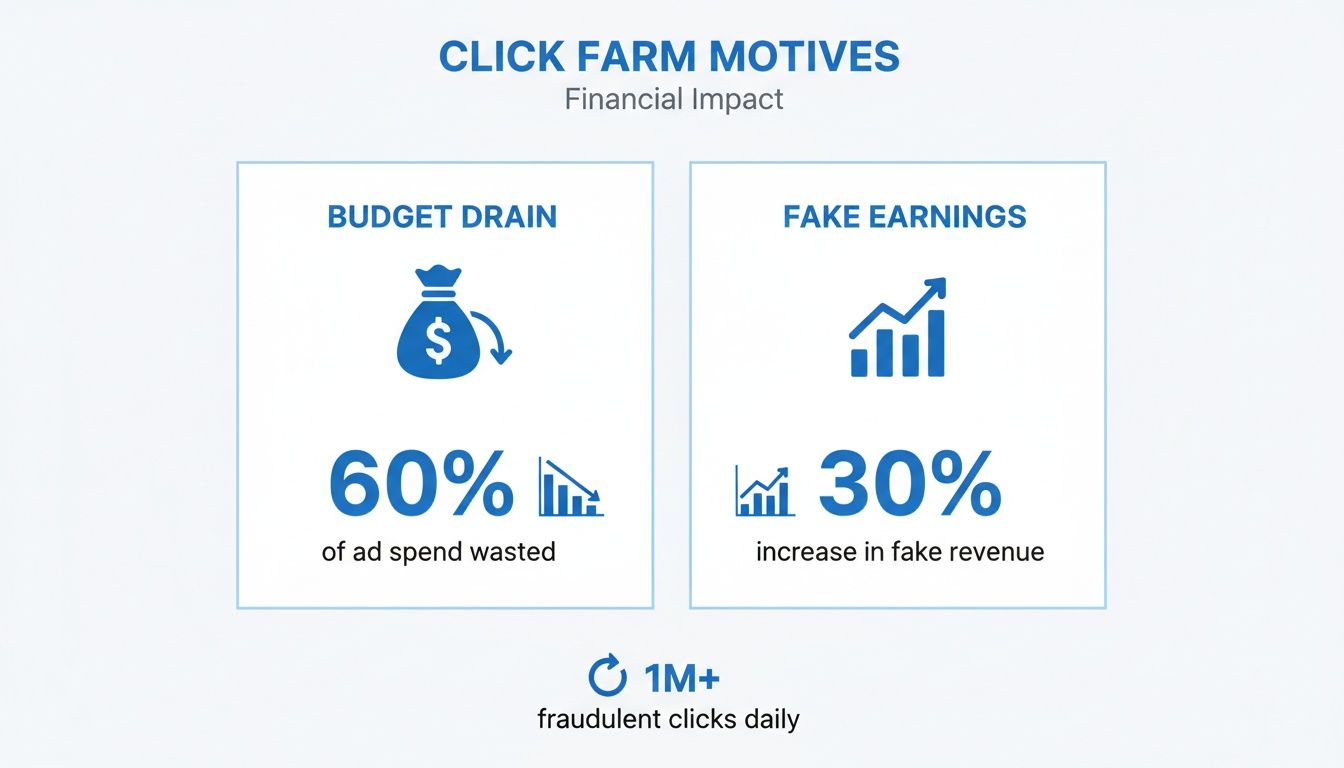
As you can see, these schemes are engineered to either exhaust a competitor's ad budget or artificially inflate a publisher's earnings—all at your expense.
The Hidden Costs of Corrupted Data
The immediate budget drain is just the tip of the iceberg. The real long-term damage comes from how this flood of bad data poisons Google's optimization algorithms, steering your campaigns in the wrong direction.
When a click farm inflates your click-through rate (CTR), Google's algorithm interprets this as a positive signal of ad relevance. In response, it may start prioritizing your ad in auctions that reach these fraudulent sources, effectively rewarding the attackers with more of your budget. This can lead the algorithm to make poor optimization decisions, such as increasing your bids for low-quality traffic, which drives up your cost per acquisition (CPA) and guts your campaign's overall efficiency.
The financial toll of click farm fraud represents a massive vulnerability in the digital advertising economy. Projections now place the annual worldwide cost of click fraud at over $100 billion, transforming a strategic investment into a high-stakes gamble for uninformed businesses.
The scale of this issue is immense. As the PPC market expands, so does the incentive for fraud. With global ad spend rising, it's estimated that roughly one in every six PPC clicks is fraudulent—a staggering 16.7% of all paid traffic. This invalid activity warps key performance indicators. For example, conversion rates from fraudulent traffic are often half that of genuine users, which inflates your costs and misguides Google's automated bidding strategies. You can find more up-to-date Google Ads benchmarks and insights on WordStream.com.
How to Spot the Telltale Signs of a Click Farm Attack
Think of yourself as a data detective for your Google Ads account. You must be vigilant for anomalies that don't align with legitimate customer behavior. Identifying a click farm google ads attack early is crucial to mitigating the financial damage. The good news is that these operations almost always leave a trail of evidence within your campaign data.

The most glaring red flag is a sudden, dramatic spike in your click-through rate (CTR) that is not accompanied by a corresponding increase in conversions. A high CTR is desirable when it reflects genuine interest, but when it skyrockets without generating any leads or sales, it's a clear indicator of fraudulent activity. You're paying for traffic that delivers zero business value.
Analyze Your Traffic and Budget Patterns in Google Ads
To conduct a thorough investigation, you need to become intimately familiar with your campaign data, starting with your geographic reports. A classic symptom of a click farm attack is a large volume of traffic originating from unexpected countries or regions where you do not conduct business. If you are a local plumber in Phoenix receiving hundreds of clicks from Vietnam, you are almost certainly under attack.
Another key indicator is the rate of your daily budget depletion. Is your ad spend being exhausted hours earlier than usual, perhaps before your target audience is even online? If your budget is depleted by 9 AM when your best leads typically convert in the afternoon, it strongly suggests a coordinated, fraudulent effort is targeting your campaigns.
Click farms have become a systemic problem in digital advertising. Industries with high-value clicks, such as legal, finance, and real estate, are hit the hardest, with some experiencing fraud rates as high as 30% of their total traffic. Competitors can leverage these services to intentionally exhaust a rival's daily ad budget in minutes, which completely distorts the data fed to Google's learning algorithms. You can read more about these PPC click fraud global trends on PPCShield.io.
Spot Suspicious On-Site Behavior in Analytics
Your investigation should extend beyond the Google Ads dashboard. You also need to analyze what these "visitors" do once they land on your website. Your web analytics platform, such as Google Analytics, will often provide the definitive evidence you need.
Keep an eye out for these on-site warning signs:
- Extremely High Bounce Rates: Clicks from a click farm are almost always single-page visits. A bounce rate approaching 100% from a specific traffic source is a critical alert.
- Minimal Session Duration: These visitors do not engage with your content. If you see average session durations of just a few seconds, it is clear they are not real prospects evaluating your offer.
- Zero On-Page Interactions: Fraudulent traffic will not result in meaningful engagement. Look for a lack of scrolling, clicks on internal links, or form submissions.
These metrics help you build a clear profile of low-quality, disengaged traffic that is inconsistent with the behavior of a genuine customer.
Here’s a comparative table to help you distinguish between real users and fraudulent traffic at a glance.
Genuine User Behavior vs Click Farm Activity
| Metric | Genuine User Traffic | Suspicious Click Farm Traffic |
|---|---|---|
| Click-Through Rate (CTR) | Rises and falls with seasonality, ad copy changes, and competitive shifts. | Sudden, unusually high spikes that don't match historical performance. |
| Conversion Rate | Stays relatively consistent or improves with campaign optimizations. | Plummets to nearly 0% despite the high volume of clicks. |
| Geographic Location | Clicks come from your designated target areas (cities, states, countries). | A large volume of clicks originates from unexpected, irrelevant countries. |
| Time of Day | Clicks align with your target audience's typical online hours. | Clicks occur at odd hours (e.g., 3 AM local time) or in a concentrated burst. |
| Bounce Rate | Varies by page but generally stays within a reasonable, established range. | Extremely high, often approaching 90-100% from the suspicious source. |
| Session Duration | Visitors spend a reasonable amount of time on pages, indicating interest. | Average session duration is just a few seconds, indicating an immediate exit. |
| IP Address Patterns | Traffic comes from a diverse range of unique, residential, or business IPs. | A high volume of clicks originates from a small pool of IPs or from data centers. |
Observing one of these signs might be an anomaly, but a combination of several is a strong indication of a coordinated click farm attack.
By learning to recognize these patterns, you can confidently differentiate between a potential customer and the automated noise of a click farm. This analytical work is the first and most critical step in defending your ad spend and ensuring your budget is invested in what matters most: growing your business. For a deeper dive, check out our guide on essential digital advertising performance metrics.
Getting Ahead of the Game: How to Protect Your Google Ads Campaigns
Identifying an attack is reactive; building a robust defense is proactive and essential for protecting your ad spend. Instead of waiting to clean up the aftermath of an attack, you can take several proactive steps within your Google Ads account to create a shield against click farm google ads operations. These strategies function as an early-warning system and a protective barrier, filtering out fraudulent traffic before it can impact your budget.
Your first line of defense is taking granular control over who sees your ads. By actively managing your campaign settings, you can significantly reduce your exposure to the common sources of fraudulent traffic.
Beef Up Your Targeting and Exclusions
One of the most powerful tools in your arsenal is the IP exclusion list. As you analyze your server logs and identify suspicious IP addresses—those generating repeated clicks with no engagement—you can block them from seeing your ads again. While manual, this process is highly effective at preventing repeat offenders from wasting your budget.
Location targeting is another critical layer of your defense. It's well-known that many click farms operate from specific countries with low labor costs. If you do not offer products or services in these regions, your ads should not be appearing there.
Here’s how to refine your geographic targeting:
- Exclude High-Risk Locations: Go into your campaign settings and exclude entire countries or regions that are sending high volumes of non-converting clicks. This single action can eliminate a major source of potential fraud.
- Target with Precision: Instead of targeting an entire country, get more granular. Focus on the specific states, cities, or even postcodes where your ideal customers reside. The more precise your targeting, the smaller the attack surface for a geographically dispersed click farm.
A common tactic in competitive markets is using click farms to drain a rival’s budget. These attacks can neutralize a campaign in minutes, with some farms generating "hundreds of thousands of clicks in mere minutes." This forces legitimate advertisers to either exhaust their budget or pause their campaigns. This is part of a larger problem, with some industries seeing search campaign fraud rates as high as 14-22% and brands losing 15-25% of their ad spend annually. You can learn more about the impact of click farm attacks from Anura.io.
Set Up Smarter Conversion Tracking
Your conversion tracking setup is more than a reporting tool; it's the primary way you train Google’s algorithm to identify a valuable customer. If you only track low-value actions like page views, you are teaching the algorithm that any click has potential value. This is a flawed strategy, as it rewards the exact type of low-engagement traffic produced by click farms.
Instead, you must focus on tracking high-intent actions that signal a genuine lead or sale. This trains the algorithm to prioritize users who exhibit behaviors consistent with your existing customers.
Key conversions you should be tracking include:
- Form Submissions: The clearest signal of a new lead.
- Phone Calls: Track calls originating from ads or your website.
- Key Page Visits: Such as "thank you" or "order confirmation" pages that a user only sees after converting.
- eCommerce Transactions: Directly measure the revenue generated by your ads.
When you optimize your campaigns for these meaningful conversions, your account becomes a far less attractive target for fraudsters. Google's Smart Bidding strategies will actively seek users who resemble your past converters, naturally filtering out the low-engagement clicks characteristic of a click farm google ads attack.
Keep a Close Eye on Your Display Network Placements
The Google Display Network (GDN) can be a fertile ground for publisher-driven click fraud. Unscrupulous website owners may hire click farms to inflate clicks on the ads they host, thereby increasing their own ad revenue at your expense.
This necessitates vigilant monitoring of where your display and video ads are being shown.
Make it a routine to regularly review your placement reports in Google Ads. Look for websites or YouTube channels with abnormally high click-through rates paired with conversion rates at or near zero. These are major red flags. Once you identify a suspicious placement, add it to your exclusion list immediately. This prevents your ads from appearing on that site or channel again, preserving your budget for placements that deliver results.
For advertisers seeking an even more robust defense, specialized third-party click fraud detection tools are the next logical step. These services act as an automated, 24/7 security system, using advanced algorithms to identify and block fraudulent IPs in real time.
How to Report Fraud and Request Refunds from Google
Even with a strong defensive strategy, a sophisticated click farm google ads attack can sometimes penetrate your defenses. When this occurs, the next step is to report the incident to Google and file for a refund on the invalid clicks you were charged for. It requires meticulous documentation, but it is the only way to potentially recover your wasted ad spend.
Think of yourself as building a case file for an investigation. You cannot simply inform Google that you suspect fraud; you must provide concrete evidence. While their automated detection systems are powerful, they are not infallible. A well-documented report from an advertiser is often the catalyst for a manual review and a credit to your account.
Gathering Your Evidence for a Refund Request
Before submitting a support ticket, you must organize your evidence. The more detailed your documentation, the higher the probability of a successful refund claim. Your goal is to present a clear, undeniable case of fraudulent activity.
Here's a checklist of the evidence you need to collect:
- Suspicious IP Addresses: This is your most critical piece of evidence. Compile a list of all IP addresses exhibiting fraudulent patterns, such as an unusually high number of clicks in a short period.
- Web Server Logs: Your server logs provide the raw data to substantiate your claim. Export logs corresponding to the attack dates and be prepared to highlight the specific IPs and their click patterns.
- Campaign Performance Reports: Take screenshots from your Google Ads dashboard that clearly illustrate the anomaly. Focus on charts showing a sudden, unnatural spike in clicks, a corresponding drop in conversion rate, or a surge in traffic from irrelevant geographic locations.
Compiling this evidence transforms your suspicion into a documented incident that Google's team can investigate effectively.
Submitting Your Claim and Setting Expectations
Once your evidence is compiled, submit your request through Google's official Invalid Clicks contact form. In your description, be concise and factual. Explain why you believe the traffic is fraudulent, specify the affected campaigns, and provide the exact date range of the attack.
It is crucial to be patient. Google receives a high volume of these requests and conducts thorough investigations. They will cross-reference your data with their own internal traffic logs to validate your claim.
While Google's automated filters catch a significant amount of invalid traffic before you are charged, they don't catch everything. Filing a manual refund request is your right as an advertiser and a necessary step to ensure you only pay for legitimate clicks.
The entire process can take several weeks. Google will only issue a credit if their investigation confirms the activity was invalid according to their policies. Not every claim is approved, but a strong, evidence-backed case gives you the best possible chance of ensuring you are not the one footing the bill for a click farm google ads attack.
Frequently Asked Questions About Google Ads Click Fraud
Navigating the complexities of click fraud can be daunting, and it's natural to have questions. Even seasoned advertisers encounter scenarios that require clarification. Let's address some of the most common questions to help you protect your campaigns with confidence.
What's the Difference Between Bot Traffic and a Click Farm?
Think of it as the difference between automated robots and an organized human workforce. This distinction is critical because they represent different types of threats to your Google Ads account.
Bots are software scripts, typically running on servers, programmed to repeatedly click your ads. They often operate at a massive scale and can be unsophisticated, leaving obvious digital footprints like thousands of clicks originating from a single data center IP address. Because their behavior can be predictable, Google's automated systems are generally effective at identifying and filtering out this type of basic bot traffic.
Click farms are a more advanced threat. They use real human beings operating real devices like smartphones and computers. These workers are paid to mimic legitimate customer behavior—they might scroll a landing page, pause for a few seconds, and then click an ad. This human element makes their fraudulent activity much harder to distinguish from genuine user interest, posing a more sophisticated and dangerous challenge for advertisers.
"A common misconception is that all invalid traffic is just bots. In reality, human-powered click farms are a growing problem because they can bypass simple fraud filters, making manual oversight and advanced protection essential for advertisers who want to protect their budget."
This is why a campaign's top-level metrics can appear healthy while, in reality, its budget is being siphoned off by an army of fraudulent, human-driven clicks.
Doesn't Google Already Protect Me from Click Fraud?
Yes, Google invests heavily in protecting advertisers. It employs a powerful, multi-layered system that automatically filters a vast amount of invalid traffic before it affects your billing. This includes known bots, automated clicking tools, and other common sources of fraud. This system serves as your primary line of defense.
However, no system is perfect. The operators of click farm google ads schemes are constantly innovating to circumvent Google’s defenses. They use residential IP addresses, real devices, and simulated human behavior specifically to blend in with legitimate traffic and evade detection.
Think of Google's protection as a city's main wall—it stops the majority of attacks. But you still need your own security patrols. By actively monitoring your account data, maintaining IP exclusion lists, and refining your targeting, you can catch the more sophisticated threats that slip through. Relying solely on Google's automated protection is an incomplete strategy.
Can Using a Fraud Detection Tool Hurt My Google Ads Account?
No, using a reputable third-party fraud detection tool is completely safe and will not penalize your Google Ads account. These platforms are designed to work in conjunction with Google's systems and are fully compliant with Google's terms of service.
These tools function by analyzing your traffic data for suspicious patterns indicative of fraud. When they identify a malicious IP address, they use the official Google Ads API to add that IP to your campaign's exclusion list.
This is a standard feature that Google provides to all advertisers. You could perform this action manually, but these tools automate the process at a scale and speed that a human cannot match. They are an extension of your own management efforts, not a "black hat" technique that violates policy.
What Is the First Thing I Should Do If I Suspect an Attack?
If you suspect your campaigns are under attack from a click farm, your immediate priority is to stop the financial bleeding. Do not delay action to investigate while your budget is actively being drained.
The very first thing you should do is pause the specific campaigns or ad groups that appear to be affected. This immediately halts ad spend on fraudulent clicks and provides you with the breathing room to conduct a thorough investigation without the pressure of a running meter.
Once the campaigns are paused, you can begin your analysis to gather the evidence needed to build your case and strengthen your defenses.
- Document the Timeline: Identify the exact dates and times when you first observed the suspicious activity.
- Analyze Geographic Data: Look for a sudden influx of traffic from countries or regions where you do not do business.
- Review Performance Metrics: Take screenshots of the anomalous spike in your click-through rate (CTR) and the corresponding decline in your conversion rate.
- Identify Suspicious IPs: Dive into your server logs to pinpoint the specific IP addresses responsible for the low-quality traffic.
This data is crucial not only for submitting a refund request to Google but also for updating your IP exclusion lists before reactivating your campaigns.
Stop wasting your budget on ghost leads and fake clicks. With Pushmylead, you get instant notifications for every new lead from your Google Ads campaigns, allowing you to spot suspicious patterns in real time and act fast. Protect your ad spend and focus on the leads that truly matter by visiting https://www.pushmylead.com today.