
You've optimized your bidding strategy, perfected your audience targeting, and set a robust budget for your Google Ads campaigns. Yet, the conversions just aren't coming in. Clicks are expensive, and without a strong return on ad spend, you're essentially burning cash. The missing piece of the puzzle often isn't the algorithm; it's the words on the screen. The best ad copywriting is the engine that turns a viewer’s passing glance into a qualified lead or a sale. It’s the critical link between your campaign’s technical setup and its financial success.
This article cuts through the noise of generic advice. We're providing a comprehensive roundup of 10 proven copywriting frameworks and psychological triggers specifically engineered for the Google Ads ecosystem, including Search, Discovery, and YouTube campaigns. These aren't abstract theories but actionable blueprints designed for marketing agencies and consultants who need to deliver measurable results. Before diving into the specific words that sell, it's helpful to ensure your foundational advertising plan is solid. You can learn more about practical strategies for advertising small businesses to build a strong base for your copywriting efforts.
Here, you will find a tactical toolkit filled with real-world examples and ready-to-use copy snippets you can paste directly into your headlines, descriptions, and lead forms. We'll break down powerful models like AIDA and PAS, explore the use of emotional triggers, and show you how to craft a Unique Value Proposition that stands out. Get ready to transform your ad performance and prove the tangible value of compelling copy.
1. The AIDA Model (Attention, Interest, Desire, Action)
The AIDA model is more than a classic marketing acronym; it’s a strategic blueprint for guiding potential customers from awareness to conversion. As one of the foundational pillars of the best ad copywriting, this framework structures your ad’s message to align perfectly with the user’s decision-making process. It’s particularly effective in the Google Ads ecosystem, where you have seconds to make an impact in a Responsive Search Ad or a Performance Max asset.
The model works by moving the user through four sequential stages:
- Attention: Grab the user's focus immediately with a high-relevance headline.
- Interest: Hold their attention with benefits that match their search intent.
- Desire: Transform interest into a want for your specific offer.
- Action: Prompt them to take the next step with a clear call-to-action.
By structuring your ad copy this way, you create a logical and persuasive flow that prevents users from dropping off midway. It’s a reliable method for turning a simple search query into a qualified lead or sale.
How to Apply AIDA to Google Ads Copy
Let’s break down how to implement AIDA in a Google Responsive Search Ad for a fictional CRM software, "ConnectSphere."
-
Attention (Headline): Your headline must stop the user. In Google Ads, this means matching the search query or asking a compelling question.
Example Headline:
Tired of Losing Leads? - ConnectSphere CRM -
Interest (Description): Now that you have their attention, deliver value. Highlight specific, tangible benefits that solve their problem, which improves your Ad Rank.
Example Description:
Stop juggling spreadsheets. Our AI-powered CRM automatically tracks follow-ups, organizes contacts, and identifies your hottest leads in real-time. -
Desire (Description): This is where you connect emotionally. Use social proof, highlight exclusive benefits, or create a sense of urgency to make your offer irresistible.
Example Description:
Join 10,000+ sales teams who close 30% more deals. Imagine never missing a follow-up again. Get your personalized demo. -
Action (Call-to-Action): Be direct and unambiguous. Tell users exactly what you want them to do next. Use strong, action-oriented verbs. Google Ads often provides pre-set CTA options; choose the one that aligns best.
Example CTA:
Book Your Free Demo NoworStart Your Free Trial
2. Power Words and Emotional Triggers
Power words are persuasive, emotionally-charged terms that trigger a psychological or emotional response. In the context of Google Ads, where character counts are tight, every word matters. Power words are strategic tools in the best ad copywriting that bypass rational thought and speak directly to a user's core motivations like fear, curiosity, safety, and desire.
Power words work by tapping into the primal parts of the brain that drive decision-making. Words like 'Proven,' 'Guaranteed,' 'Secret,' and 'Exclusive' can increase your Click-Through Rate (CTR) by making your ad stand out from the competition. Using them can also positively impact your Quality Score by improving expected CTR.
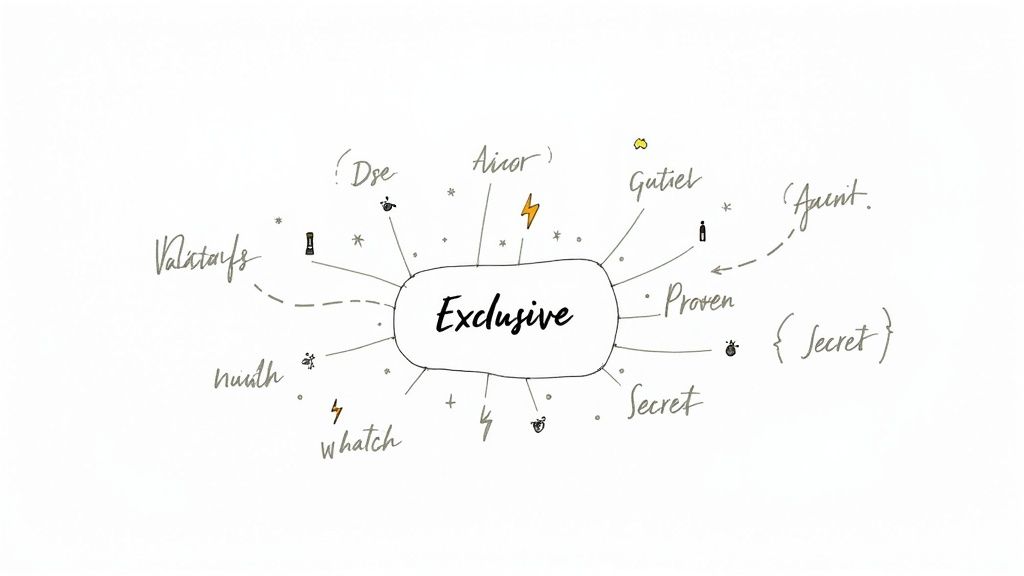
This technique is about precision. By choosing the right emotional trigger, you can significantly increase click-through rates and conversions without changing your core offer.
How to Apply Power Words to Google Ads Copy
Let’s apply this concept to a Google Responsive Search Ad for an online cybersecurity course.
-
Attention (Headline): Your headline must create an immediate emotional connection. Use power words that evoke curiosity, urgency, or a sense of security.
Example Headline:
Unlock Elite Cybersecurity Secrets - Limited Spots -
Interest (Description): Reinforce the headline's emotional promise with benefits that feel tangible and vital. Use words that highlight simplicity, speed, or effectiveness.
Example Description:
Discover the proven methods top ethical hackers use. Our step-by-step blueprint makes complex concepts simple and immediately applicable. -
Desire (Description): Amplify the want for your solution by using words that suggest exclusivity and transformation. Make the user feel they are gaining a unique advantage.
Example Description:
Join an exclusive community of certified pros. Get lifetime access to our revolutionary threat-detection toolkit. Don't get left behind. -
Action (Call-to-Action): Your CTA should use a powerful verb that implies a valuable outcome, not just a click. Make the next step sound like an opportunity.
Example CTA:
Claim Your Spot NoworGet Instant Access
3. The Problem-Agitation-Solution (PAS) Framework
The Problem-Agitation-Solution (PAS) framework is a powerful and persuasive copywriting formula that leverages human psychology to drive action. Instead of leading with a benefit, PAS taps directly into a prospect's pain points, making it one of the best ad copywriting techniques for grabbing immediate attention. It’s highly effective in Google Ads, where users are actively searching for solutions to their problems.
The framework is built on a simple, three-step emotional journey:
- Problem: Identify the specific pain point that matches the user's search query.
- Agitate: Intensify the problem by highlighting the frustrations and negative consequences associated with it.
- Solution: Introduce your product or service as the clear and direct answer to that agitated problem.
By first validating the user’s struggle and then amplifying it, you create a powerful need for your solution. This makes your offer feel less like a sales pitch and more like a timely rescue, leading to higher conversion rates on your landing page.
How to Apply PAS to Google Ads Copy
Let’s apply the PAS framework to a Google Search Ad for a fictional automated accounting software, "FinFlow."
-
Problem (Headline): Hook the user by calling out a familiar and frustrating problem. Be direct and specific to their search intent.
Example Headline:
Hate Chasing Invoices? - Try FinFlow -
Agitate (Description): Now, twist the knife. Remind them of the negative emotions and wasted time caused by the problem. Use relatable language to make the pain feel real.
Example Description:
Late payments are stressing you out. Endless follow-up emails are killing your productivity. Stop letting manual tasks hurt your cash flow. -
Solution (Description): Position your service as the perfect resolution. Clearly state how you eliminate the agitated pain points, providing relief and a clear path forward.
Example Description:
FinFlow automates invoice reminders and payment tracking. Get paid faster without the hassle. See why businesses love our automated system. -
Action (Call-to-Action): Your CTA should reinforce the solution. It’s the final step that delivers them from their problem.
Example CTA:
Automate Your Invoicing TodayorStart Saving Time Now
4. Storytelling and Narrative Copywriting
Storytelling transforms dry product features into compelling narratives that audiences connect with on an emotional level. Instead of just listing facts, this approach takes potential customers on a journey where they are the protagonist. This is a cornerstone of the best ad copywriting because stories are inherently more memorable and persuasive than statistics alone, creating deeper brand loyalty.
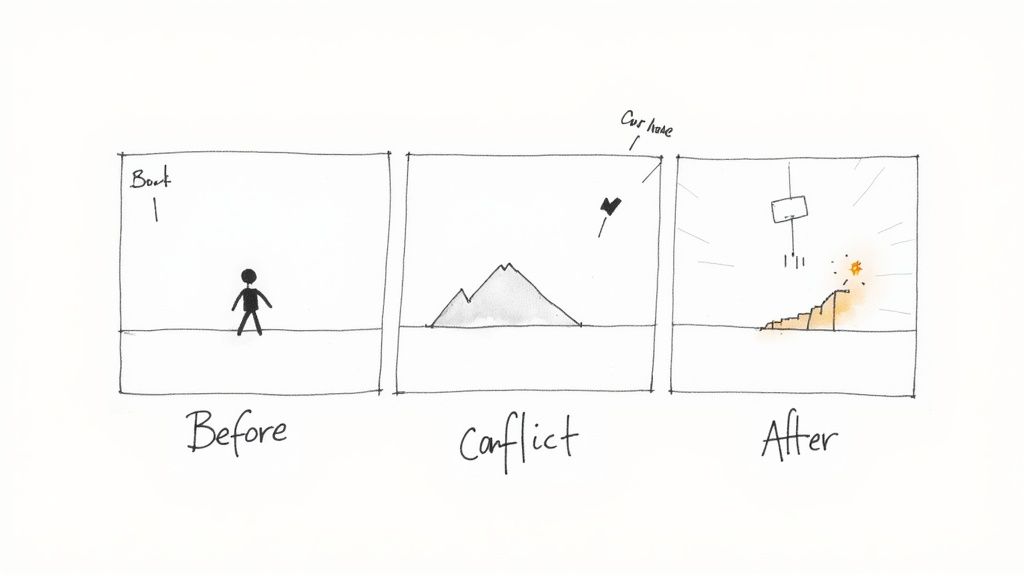
This method follows a classic structure: introduce a hero (the customer) with a problem, present a guide (your brand) with a solution, and show their successful transformation. In the Google Ads ecosystem, narrative elements can be woven into YouTube video ad scripts (like TrueView for Action), Discovery ad descriptions, and even concise search ad copy to make your message stand out.
- Problem: The customer faces a challenge or obstacle.
- Solution: Your product or service is the tool that helps them overcome it.
- Success: The customer achieves their desired outcome, transformed for the better.
This framework shifts the focus from your brand to the customer's success, making your ad feel less like a sales pitch and more like a helpful guide. It’s a powerful way to build trust and resonate with users on a human level.
How to Apply Storytelling to Google Ads Copy
Let’s create a narrative-driven Google Discovery Ad for a financial planning app called "FutureProof." Discovery ads are ideal for this, as they appear in content-rich feeds where users are open to exploration.
-
Problem (Headline): Frame the user's struggle as the beginning of a story. Start with the conflict they feel.
Example Headline:
Feeling Lost in Your Financial Future? -
Solution (Description): Introduce your brand as the guide that offers a clear plan. Show them the path forward, not just the tool.
Example Description:
We know planning for retirement is overwhelming. FutureProof gives you a simple, step-by-step roadmap. No jargon, just clarity. -
Success (Description): Paint a picture of the "after" state. What does life look like once their problem is solved? Connect this to their deeper desires for security and freedom.
Example Description:
Imagine feeling confident and in control of your finances. Join thousands who are now building their dream retirement with ease. Start your journey. -
Action (Call-to-Action): The CTA is the first step in their new story. Make it an invitation to begin their transformation.
Example CTA:
Create Your Financial PlanorFind Your Financial Clarity
5. The Unique Value Proposition (UVP) and Differentiation
Your Unique Value Proposition (UVP) is the cornerstone of effective advertising. It’s a concise statement that clearly answers a potential customer’s most important question: “Why should I buy from you instead of your competitor?” In the crowded Google Ads search results page, a strong UVP is what makes your ad stand out, cutting through the noise to connect directly with your ideal audience.
A UVP isn’t just a slogan; it’s a strategic declaration of the unique benefit you deliver. It focuses on the specific, tangible value that sets you apart. Crafting a powerful UVP is a critical component of the best ad copywriting because it forces you to define your core advantage and communicate it with absolute clarity, ensuring your message resonates and drives clicks.
By leading with your UVP, you immediately qualify your audience. You attract users who are looking for exactly what you offer and deter those who aren't, improving click-through rates and a more efficient ad spend.
How to Apply a UVP to Google Ads Copy
Let’s apply this to a Google Responsive Search Ad for "Streamline," a project management tool for creative agencies.
-
Attention (Headline): Your headline must immediately signal your key differentiator. Lead with the most compelling part of your UVP.
Example Headline:
Finally, PM Software for Creatives -
Interest (Description): Expand on the headline. Explain how you deliver on that unique promise and what makes it better than the generic alternatives they’ve already seen.
Example Description:
Stop forcing your team into rigid, spreadsheet-based tools. Streamline is built for visual collaboration with integrated proofing and client feedback portals. -
Desire (Description): Reinforce the unique outcome. Use social proof or specific benefits that only you can provide to make your solution the obvious choice. To further develop this crucial element for differentiation, consider exploring insights on crafting a compelling value proposition.
Example Description:
Trusted by 500+ top agencies to cut project times by 25%. Eliminate endless email chains and get approvals faster. -
Action (Call-to-Action): Your CTA should align with the value you’ve just presented. It’s the final step in your UVP-driven message.
Example CTA:
See How It WorksorStart Simplifying Projects
6. Social Proof and Testimonial Copywriting
Social proof is a psychological principle where people assume the actions of others reflect the correct behavior for a given situation. In the world of best ad copywriting, this translates to building trust and credibility by showing that other people already value your product or service. This technique is especially potent in Google Ads, where you must overcome user skepticism instantly. You can leverage this via ad extensions like Seller Ratings.
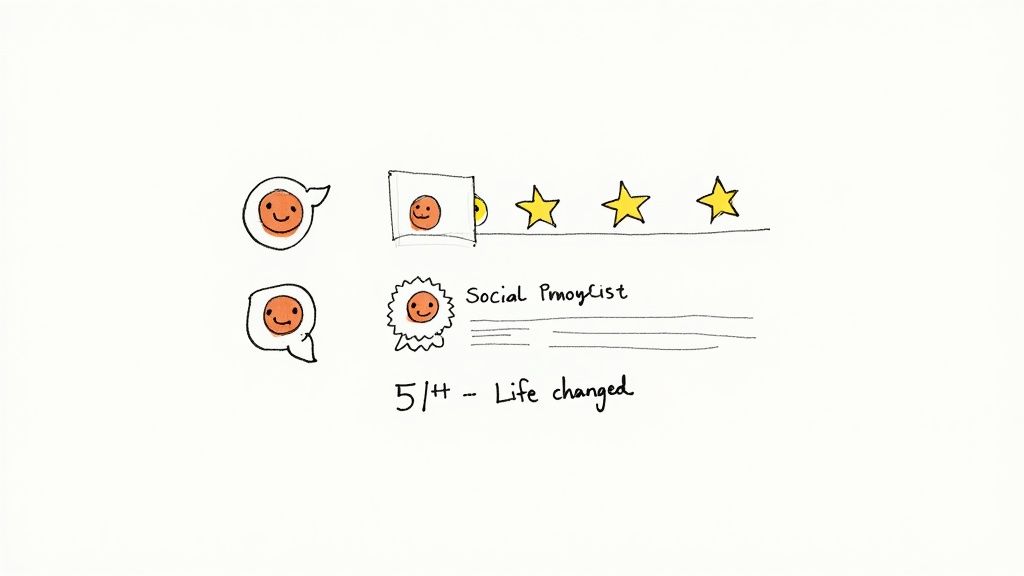
By integrating customer quotes, user statistics, awards, and reviews directly into your copy, you provide third-party validation that your own claims can’t match. It addresses the user’s primary question: "Can I trust this?" The answer is a resounding "yes," supported by a chorus of satisfied customers.
How to Apply Social Proof to Google Ads Copy
Let's see how to weave social proof into a Google Ads campaign for a B2B SaaS company specializing in project management software, "TaskFlow."
-
Attention (Headline): Lead with your strongest piece of social proof. Numbers and prestigious names grab attention immediately.
Example Headline:
Trusted by 50,000+ Teams Globally - TaskFlow -
Interest (Description): Use the description to add context to your social proof. Mention recognizable clients or highlight impressive statistics that speak directly to your target audience's goals.
Example Description:
Join teams from Google & Shopify who use TaskFlow to deliver projects 40% faster. See how our platform can streamline your workflow. -
Desire (Description): Connect the social proof to a tangible benefit. Incorporate a short, powerful quote or a review rating to make the positive outcome feel real and attainable for the new user.
Example Description:
"TaskFlow cut our planning time in half." - Mark L., Project Manager. G2 Rated 4.9/5. Stop wasting time in meetings. -
Action (Call-to-Action): Place your call-to-action right after the strongest piece of proof to leverage the built-up trust and encourage an immediate click.
Example CTA:
See Plans & PricingorStart Your Free Trial Today
7. Benefit-Driven Copy vs. Feature-Focused Copy
One of the most common mistakes in ad copywriting is listing what a product is instead of what it does for the customer. This is the core difference between feature-focused and benefit-driven copy. A feature is a factual statement about your product, while a benefit is the positive outcome or emotional result a customer gets from that feature. The best ad copywriting always prioritizes benefits.
This technique works by answering the customer’s unspoken question: “What's in it for me?” Customers don’t buy a 10-hour battery; they buy the freedom from worrying about their phone dying. Translating features into benefits connects your product directly to your audience’s needs, which is a key factor in improving Ad Relevance, a component of Quality Score.
- Feature: A factual characteristic of your product (e.g., "AI-powered scheduling").
- Benefit: The positive impact on the customer's life (e.g., "Save 10 hours a week on admin").
This approach is crucial in the competitive Google Ads landscape, where users are actively searching for solutions. Leading with the solution (the benefit) instantly communicates your value and sets you apart from competitors who just list technical specs.
How to Apply Benefit-Driven Copy to Google Ads
Let’s translate features into benefits for a Google Responsive Search Ad promoting a project management tool called "TaskFlow."
-
Feature-Focused (Weak): Start by identifying the product's features.
Our software has Gantt charts, real-time collaboration, and automated reporting. -
Benefit-Driven Translation (Strong): Now, translate each feature into a clear benefit by asking "So what?"
- Gantt charts → Benefit:
Visualize Your Entire Project Timeline Instantly - Real-time collaboration → Benefit:
Keep Your Team Synced & Eliminate Bottlenecks - Automated reporting → Benefit:
Stop Wasting Hours on Manual Reports
- Gantt charts → Benefit:
-
Putting It All Together (Headline & Description): Weave these benefits into your ad copy, leading with the most impactful outcome.
Headline Example:
Never Miss A Deadline Again - TaskFlow
Description Example:Visualize project timelines, keep teams synced, and automate reports. Stop wasting hours on manual updates and hit your goals faster. Start your free trial.
By focusing on what the user gains, you transform a dry list of specs into a compelling promise of a better, more efficient work life.
8. Urgency and Scarcity Copywriting Tactics
Urgency and scarcity are powerful psychological triggers that motivate immediate action. This technique leverages the principle of loss aversion, where the fear of missing out (FOMO) is often a stronger motivator than the prospect of gaining something. As a core component of the best ad copywriting, it’s highly effective in the Google Ads environment for accelerating conversions.
These tactics work by creating a sense of pressure, implying that an opportunity is limited by either time or quantity:
- Urgency: Creates a time-sensitive deadline. The offer will expire soon.
- Scarcity: Highlights limited availability. The product or spot might run out.
A powerful tool for this in Google Ads is the Countdown Customizer, which dynamically updates your ad copy to show how much time is left on a promotion. This can dramatically increase CTR for sales-focused campaigns.
How to Apply Urgency and Scarcity to Google Ads Copy
Let's break down how to implement these tactics in a Google Responsive Search Ad for an online digital marketing course.
-
Urgency (Headline): Use time-based language to create a clear deadline. The Countdown Customizer is perfect for this, as it automatically updates.
Example Headline:
Enrollment Closes in 2 Days | SEO Mastery Course -
Scarcity (Description): Highlight the limited number of available spots or products. This creates exclusivity and increases perceived value.
Example Description:
Only 15 seats left for our live expert Q&A session. Secure your spot before they’re all gone and start ranking higher. -
Urgency + Value (Description): Combine the deadline with a clear benefit or discount to reinforce what the user stands to lose if they don't act now.
Example Description:
Our 40% off early-bird discount ends Friday. Don't miss your chance to master SEO with hands-on training from industry leaders. -
Action (Call-to-Action): Your CTA should echo the urgency and guide the user to the immediate next step.
Example CTA:
Enroll Now & Save 40%orClaim Your Spot Today
9. Conversation and Casual Tone Copywriting
Conversational copywriting sheds the corporate jargon and speaks to users like peers, not targets. This approach builds instant rapport by using a friendly, natural tone. In the fast-paced Google Ads environment, where trust must be earned in seconds, a casual tone can make your brand feel more human, approachable, and memorable.
This style uses everyday language to break down barriers, making your message more persuasive and relatable. By speaking directly to the user with "you" and "your," you create a one-on-one dialogue that cuts through the noise of stiff, formal ad copy. This approach often leads to better ad engagement and can positively influence your overall Ad Rank.
How to Apply a Casual Tone to Google Ads Copy
Let's apply this conversational approach to a Google Search Ad for a project management tool called "TaskFlow."
-
Attention (Headline): Start with a relatable problem or a friendly question. This feels less like an ad and more like helpful advice.
Example Headline:
Team Projects a Mess? | Let's Get Organized -
Interest (Description): Use simple language and contractions to explain the benefits. Write as if you were explaining the tool to a friend over coffee.
Example Description:
Tired of chasing updates? TaskFlow puts everything in one place. You'll always know who's doing what and when it's due. It's that simple. -
Desire (Description): Make the user feel understood. Show empathy for their pain points and position your product as the easy, no-fuss solution.
Example Description:
Finally, a tool your team will actually want to use. No more complicated setups. Just clear, stress-free project tracking. Get your weekends back! -
Action (Call-to-Action): Your CTA should sound like an invitation, not a command. Keep it friendly and low-pressure to encourage clicks.
Example CTA:
See How It WorksorGive It a Try - Free
10. The 'Before-After-Bridge' (BAB) Framework
The Before-After-Bridge (BAB) framework is a powerful narrative tool that taps into a fundamental human desire: transformation. It works by painting a vivid picture of a customer's problem (the Before state), showing them an aspirational future (the After state), and then presenting your product or service as the clear path (the Bridge) between the two. This technique is a cornerstone of the best ad copywriting because it shifts the focus from features to outcomes.
BAB is incredibly effective in Google Ads because it quickly connects a user's current pain point, which prompted their search, to a tangible, desirable solution. The framework operates on a simple, persuasive logic:
- Before: Acknowledge and empathize with the user's current problem.
- After: Help them visualize a future where that problem is solved.
- Bridge: Introduce your offer as the vehicle for that transformation.
By structuring your ad this way, you create an emotional connection and a clear value proposition. You’re not just selling a service; you're selling a better version of the user's future.
How to Apply BAB to Google Ads Copy
Let’s apply the BAB framework to a Google Responsive Search Ad for a fictional career coaching service called "CareerLeap."
-
Before (Headline): Start by mirroring the user's current frustration. Your headline should reflect the exact problem they are trying to solve.
Example Headline:
Stuck in a Dead-End Job? - Find Your Purpose -
After (Description): Describe the ideal outcome. What does life look like after they use your service? Make it aspirational but believable.
Example Description:
Imagine waking up excited for work. Land a role that aligns with your passion and doubles your impact. Your dream career is closer than you think. -
Bridge (Description): Now, present your service as the clear, simple solution. Explain how you make the transformation happen. This is where you introduce your unique mechanism.
Example Description:
Our proven career transition framework helps you identify your strengths and connect with top employers. Get personalized coaching and interview prep. -
Action (Call-to-Action): Tell them precisely how to start their journey across the bridge. The CTA should feel like the first logical step toward their "After" state.
Example CTA:
Book a Free Strategy CallorStart Your Career Plan
Top 10 Ad Copywriting Techniques Comparison
| Technique | Implementation complexity 🔄 | Resource requirements ⚡ | Expected outcomes 📊⭐ | Ideal use cases 💡 | Key advantages ⭐ |
|---|---|---|---|---|---|
| The AIDA Model (Attention, Interest, Desire, Action) | Low — four-step sequential formula | Low — one copywriter, minimal research | Consistent conversion lift; ⭐⭐⭐⭐ 📊 | Ads, landing pages, emails, short funnels | Clear structure; versatile across channels |
| Power Words and Emotional Triggers | Low — word-level changes, contextual nuance | Low — copy testing and audience fit checks | Immediate CTR/engagement uplift; ⭐⭐⭐⭐ 📊 | Headlines, CTAs, subject lines, ads | Quick performance lift; emotive impact |
| Problem-Agitation-Solution (PAS) | Moderate — needs precise problem framing | Medium — audience research + skilled copywriting | High persuasion for problem-aware audiences; ⭐⭐⭐⭐ 📊 | Direct response, sales pages, lead gen | Strong emotional pull; positions solution as relief |
| Storytelling and Narrative Copywriting | High — craft-driven, time-consuming | High — writers, creative assets, production | Deep brand affinity and memorability; ⭐⭐⭐⭐ 📊 | Brand campaigns, long-form content, video | Builds emotional bonds; differentiates brand |
| Unique Value Proposition (UVP) & Differentiation | Moderate — requires market/competitor analysis | Medium — research, cross-team alignment | Improved positioning and recall; ⭐⭐⭐⭐ 📊 | Homepages, product pages, positioning docs | Clarifies why to choose you; supports pricing |
| Social Proof & Testimonial Copywriting | Low — simple placement, needs authentic sources | Medium — collect reviews, case studies, media | Increases trust and conversions; ⭐⭐⭐⭐ 📊 | Product pages, checkouts, B2B case studies | Credibility boost; reduces perceived risk |
| Benefit-Driven vs Feature-Focused Copy | Low — process of translation (feature→benefit) | Low — product knowledge + customer insight | Higher relevance and conversions; ⭐⭐⭐⭐ 📊 | Product descriptions, headlines, sales pages | Makes value tangible; answers "so what?" |
| Urgency & Scarcity Tactics | Low — easy to add but must be genuine | Low — timers/inventory management, verification | Short-term conversion spikes; ⭐⭐⭐ 📊 | E‑commerce, flash sales, limited offers | Drives fast action; reduces decision paralysis |
| Conversation & Casual Tone Copywriting | Low — tone adjustments, consistency required | Low — skilled copywriter to maintain voice | Higher engagement and readability; ⭐⭐⭐⭐ 📊 | Social, onboarding, emails, B2C content | Builds rapport; feels authentic and relatable |
| Before-After-Bridge (BAB) Framework | Moderate — concise transformation framing | Low–Medium — visuals or examples enhance effect | Persuasive visualization of change; ⭐⭐⭐⭐ 📊 | Landing pages, transformation products, coaching | Clear journey depiction; inspires aspirational action |
Putting It All Together: Your Google Ads Copywriting Checklist
We've explored ten powerful frameworks and techniques, from the classic AIDA model to the compelling Before-After-Bridge narrative. You now have a comprehensive toolbox filled with proven strategies for crafting high-converting Google Ads copy. But the journey to achieving the best ad copywriting results doesn't end with understanding these concepts; it begins with their consistent and strategic application.
True mastery comes from viewing these frameworks not as rigid rules but as flexible instruments in your marketing orchestra. The goal is to move beyond simply writing ads and start engineering conversations that drive conversions. By combining emotional triggers with clear value propositions and backing them up with social proof, you create a persuasive force that speaks directly to your audience's deepest needs and desires.
From Theory to Action: A Practical Recap
Let's distill the core principles from this guide into an actionable checklist. Before you launch your next Google Ads campaign, run your copy through this quick audit:
- Is the Hook Strong? Does your headline immediately grab Attention (AIDA) or highlight a critical Problem (PAS)? It must stop the scroll and earn the click.
- Is the Value Clear? Have you articulated your Unique Value Proposition (UVP)? A user should know exactly why they should choose you over a competitor in seconds.
- Are You Selling the Outcome? Focus on Benefit-Driven Copy. Instead of listing features like "10GB of storage," translate that into a benefit like "Never worry about running out of space again."
- Is It Believable? Have you incorporated Social Proof? Mentioning "Trusted by 5,000+ agencies" or using Seller Rating extensions builds instant credibility.
- Does It Create Momentum? Are you using Urgency or Scarcity? Phrases like "Offer ends Friday" or using Countdown Customizers give users a compelling reason to act now.
- Is There a Compelling Narrative? Can you structure your ad using a simple Storytelling framework like BAB (Before-After-Bridge)? Show them the transformation they can achieve.
The Unspoken Rule: Test, Measure, and Iterate
The single most important takeaway is this: your first draft is never your last. The path to the best ad copywriting is paved with data-driven iteration. Google Ads' own "Ad Strength" indicator for Responsive Search Ads is a good starting point, but real-world performance data is the ultimate judge.
Your audience is unique, and the only way to discover what truly resonates is to A/B test relentlessly.
- Test Frameworks Against Each Other: Pit a Problem-Agitation-Solution (PAS) ad against a Benefit-Driven ad. See which one delivers a lower Cost Per Acquisition (CPA).
- Isolate Your Variables: Change only one element at a time. Test different headlines while keeping the description the same. Then, test different descriptions with the winning headline.
- Analyze Beyond the Click: Don't just look at Click-Through Rate (CTR). Analyze conversion rates. A headline might get more clicks but fewer conversions, making it less effective overall.
This continuous loop of testing, learning, and optimizing is what separates good Google Ads managers from great ones. It transforms copywriting from a creative guesswork game into a predictable science of persuasion and performance.
Ultimately, remember that behind every search query is a person with a problem, a need, or a goal. Your ad copy is the bridge connecting their intent to your solution. By applying these principles, you're not just writing better ads; you're building stronger connections, delivering more value, and driving measurable growth for your clients and your agency.
The most effective ad copy in the world is wasted if you can't act on the leads it generates. For lead form campaigns, speed is everything. Pushmylead closes the gap between ad conversion and sales action by instantly sending your Google Ads leads directly to your email inbox, ensuring you can connect with prospects in seconds. Stop letting your high-quality leads go cold and start converting them into customers at Pushmylead.