
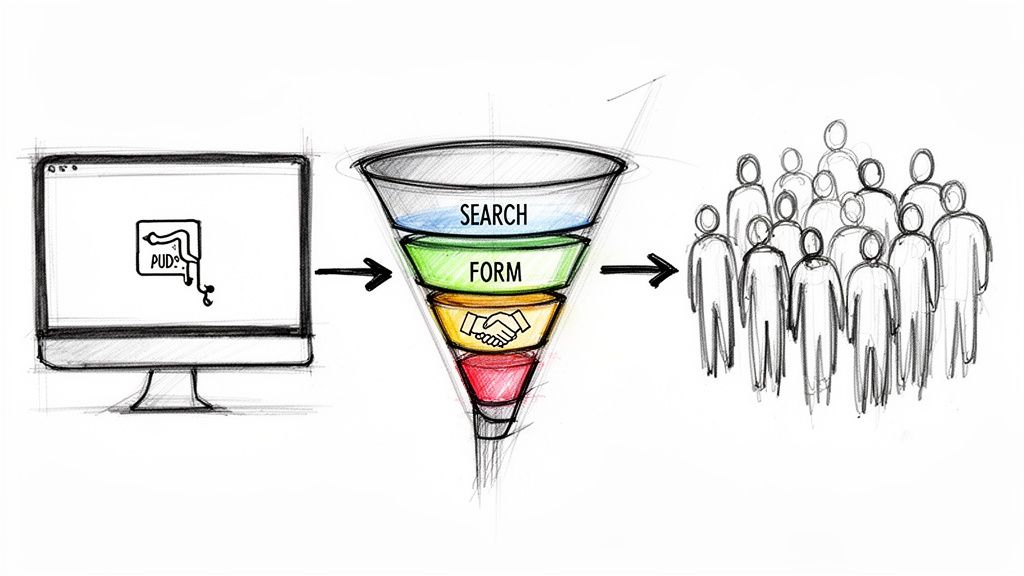
At its core, lead generation marketing is the process of identifying and cultivating potential customers for your business's products or services. Within the Google Ads ecosystem, it means transforming clicks into tangible sales opportunities. Think of it as the critical moment when an anonymous user searching on Google becomes a named contact—a real person who has raised their hand to say they're interested in what you offer.
Defining Lead Generation in the Google Ads Ecosystem
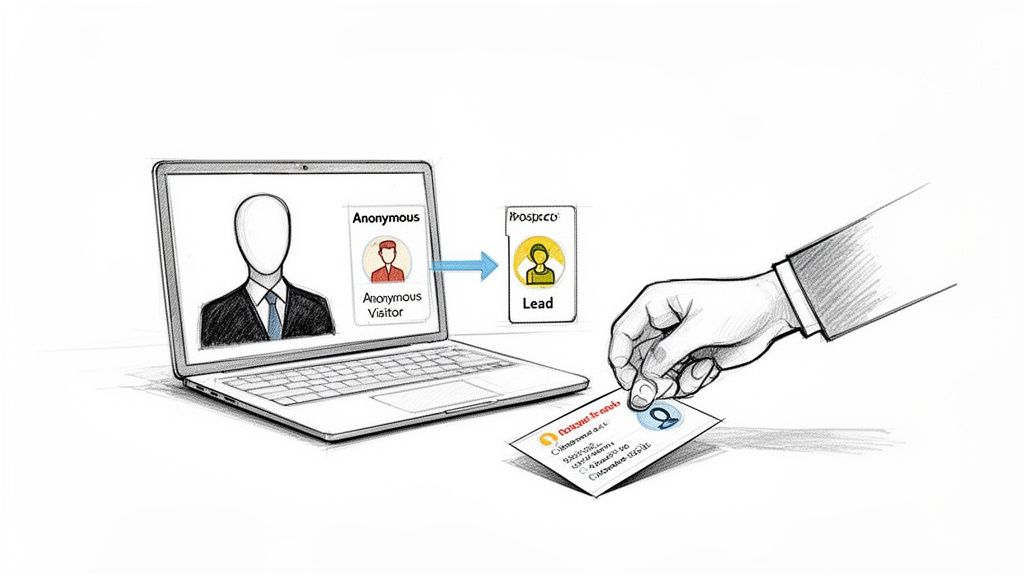
Imagine your Google Ads campaign is a highly targeted billboard on the digital superhighway. Millions of people drive by, but your ad only lights up for those actively looking for your exit. A click is when they pull over to look closer. Lead generation is the friendly concierge who greets them, answers their questions, and takes their details for a follow-up.
Instead of just broadcasting a message, you're using Google's powerful targeting to create specific opportunities for high-intent users to connect with you. This process is the engine of growth for any business that relies on pay-per-click advertising, turning ad spend into a predictable sales pipeline.
The Purpose of a Strong Lead Strategy in PPC
A sophisticated lead generation strategy does more than just fill a spreadsheet. Its purpose is to build a seamless bridge between your advertising efforts on Google and your sales team's pipeline. This involves several key functions:
- Targeting High-Intent Audiences: It starts with leveraging Google's platform to find users who are actively searching for solutions you provide.
- Capturing Interest and Information: Once a user clicks your ad, the goal is to offer something of value—a quote, a consultation, a guide—in exchange for their contact information, often via a landing page or a lead form extension.
- Qualifying and Nurturing: Not all leads are ready to buy. The process continues by nurturing these contacts, guiding them through the sales funnel until they become paying customers.
This is a massive and growing field. Recent lead generation statistics and trends show the average Cost Per Lead (CPL) on Google Search Ads is $53.43. This figure underscores the importance of an efficient strategy; every click must be optimized to capture high-quality leads that justify the investment.
In Google Ads, a lead is more than just a form submission. It's a person with an immediate problem that your ad promised to solve. Effective lead generation starts a relationship built on that promise, beginning the moment they click.
To clarify how this works within the Google Ads framework, let's look at the essential components.
Core Components of a Google Ads Lead Campaign
| Component | Description | Example for a B2B SaaS Company |
|---|---|---|
| Traffic Source | The specific Google Ads campaign type used to reach prospects. | A Google Search campaign targeting keywords like "crm for small business" and "sales automation software." |
| Lead Magnet | The valuable offer that incentivizes the user to provide their details. | An offer for a "Free 15-Minute Demo" or a downloadable whitepaper on "Improving Sales Efficiency." |
| Capture Mechanism | The tool used to collect the lead's information directly from the ad or landing page. | A Google Ads lead form extension attached to the ad for instant, frictionless submission. |
| Nurturing Process | The automated follow-up designed to move the lead towards a purchase decision. | An automated email sequence delivering case studies and inviting the lead to schedule a call with a sales rep. |
When these components are optimized and work in concert, you create a powerful system for generating predictable business growth through Google Ads.
Why a Masterful Lead Strategy Is Non-Negotiable in Google Ads
In the hyper-competitive world of Google Ads, a masterful lead generation strategy is the bedrock of survival and growth. Without a consistent and predictable flow of qualified prospects, your business is left vulnerable to rising click costs and fluctuating market demand. It’s what separates advertisers who achieve a positive ROAS (Return on Ad Spend) from those who merely burn through their budget.
A superior strategy isn't about maximizing the sheer number of leads. It's about attracting the right kind of leads—prospects who match your ideal customer profile and have a high probability of converting. This strategic filtering is how you build a robust sales pipeline that insulates your business from volatility.
From Ad Spend to Sustainable Growth
Think of your Google Ads budget as high-octane fuel. A poor lead strategy is an engine riddled with leaks; you're spending money, but the power never translates to forward motion. An efficient, optimized lead strategy ensures every dollar of ad spend is meticulously converted into measurable business momentum.
This is more critical than ever, with CPCs on the rise across most industries. By focusing on lead quality over quantity, you unlock several powerful advantages:
- Improved ROAS: Qualified leads are far more likely to convert into revenue, directly improving the return on your ad spend.
- Higher Customer Lifetime Value (LTV): Better-fit customers tend to be more successful with your product, leading to higher retention and long-term value.
- Stronger Competitive Edge: An account known for its efficiency can outbid competitors for high-value placements, attracting the best prospects in a crowded marketplace.
The ultimate goal of a Google Ads lead strategy isn't just to generate form fills. It’s to consistently create sales opportunities that have a high likelihood of becoming profitable, long-term customers.
Building a Resilient Business Model
With a dependable stream of qualified leads from your Google Ads campaigns, your business can operate from a position of strength. Instead of reacting to lulls in sales, you can proactively focus on scaling operations and improving service delivery. This is the tangible result of truly understanding what is lead generation marketing within the Google Ads context.
This predictability enables confident decision-making—from hiring sales staff to investing in new technology—all backed by the knowledge that your lead pipeline is secure. It's this stability, powered by an effective PPC strategy, that underpins long-term growth. To achieve this, understanding the top lead generation strategies for businesses is essential.
Ultimately, a masterful lead strategy is non-negotiable because it is the engine that transforms Google Ads from an expense into a primary driver of sustainable, profitable growth.
Your Toolkit for High-Quality Lead Capture
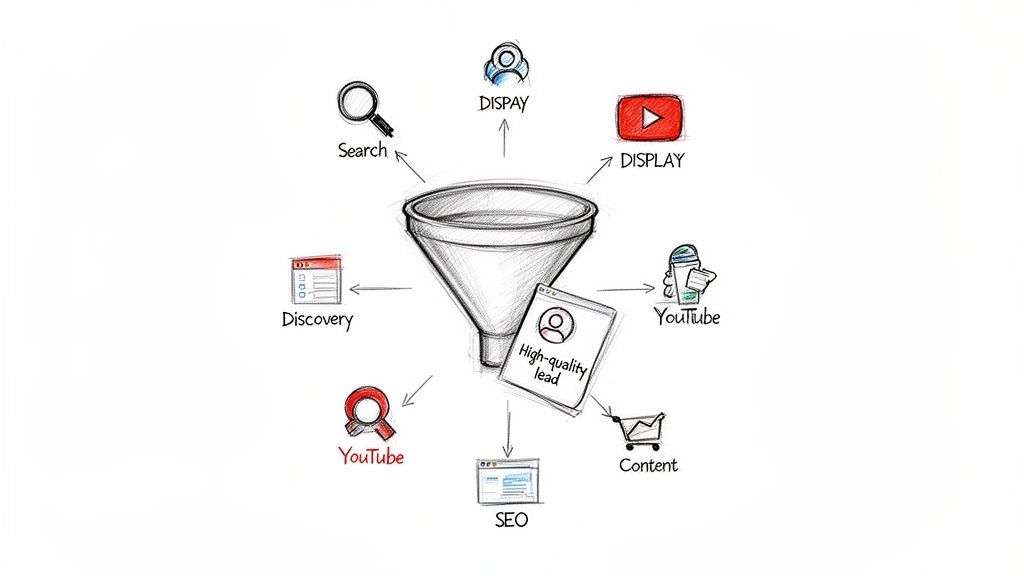
Once your strategy is defined, you need to select the right tools and campaign types from Google's extensive toolkit. Effective lead generation isn’t about using a single channel; it’s about deploying an integrated mix that engages users at different stages of their journey. The Google Ads ecosystem is a powerhouse for capturing leads, especially those with high purchase intent.
Think of Google's channels as a coordinated team. Search campaigns act as your frontline, capturing users actively seeking solutions. Meanwhile, channels like Performance Max, Display, and YouTube work to build awareness and nurture audiences who may be a perfect fit but aren't yet in "buy mode."
Mastering the Google Ads Ecosystem
The versatility of Google Ads allows you to tailor your approach for any objective, from building broad awareness to capturing leads on the verge of a decision. Each campaign type plays a distinct role in a comprehensive lead generation strategy.
Here’s how the primary Google Ads campaign types function for lead generation:
- Google Search Campaigns: The cornerstone of lead generation. You target users based on the specific keywords they search for, placing your solution in front of them at the exact moment of need. This is where you find your highest-intent leads.
- Performance Max (PMax) Campaigns: Google's newest goal-based campaign type. PMax uses machine learning to find converting customers across all of Google's channels—YouTube, Display, Search, Discover, Gmail, and Maps—from a single campaign, optimizing for your specified lead goals.
- Display Campaigns: Visual ads that appear across a network of millions of websites. They are excellent for remarketing to past website visitors and for building brand awareness with specific audiences (e.g., in-market audiences).
- YouTube Campaigns: Video is a powerful medium for storytelling and demonstration. YouTube ads, particularly in-stream and in-feed video ads, can drive direct responses through clear calls-to-action and lead form extensions.
The key to success is aligning your campaign type with your funnel stage. Use broader-reach campaigns like Display and YouTube to fill the top of your funnel. Then, leverage Search, PMax, and remarketing to convert high-intent prospects at the bottom.
The Power of Frictionless Conversion with Lead Form Extensions
One of the most powerful tools in the Google Ads arsenal is the lead form extension. This feature allows users to submit their contact information directly within your ad on Search, YouTube, or Discovery, without ever needing to visit your website. It eliminates the friction of loading a new page.
This seamless experience significantly reduces user drop-off, which often translates to higher conversion rates and a lower Cost Per Lead (CPL). The objective is simple: make it as easy as possible for an interested prospect to connect with you.
Of course, for more complex offers, a dedicated, high-converting landing page remains essential. You can learn more about creating an effective landing page for conversion in our guide.
Complementary Channels That Amplify Your Efforts
While Google Ads is a lead generation powerhouse, its effectiveness is amplified when supported by other marketing channels. These efforts build long-term authority and create a more resilient lead generation engine.
Search Engine Optimization (SEO) and Content Marketing
SEO is the organic counterpart to paid search. By creating valuable content that answers user questions, you attract high-quality traffic without paying for each click. While SEO is a long-term strategy, it builds trust and establishes your brand as an industry authority. For instance, knowing how to build a chatbot for lead generation can enhance your content's interactive lead-capture capabilities.
Social Media Marketing
For B2B advertisers, platforms like LinkedIn are indispensable. Data shows that 89% of B2B marketers use LinkedIn for lead generation. Its native Lead Gen Forms boast an average conversion rate of 13%, dwarfing the typical landing page conversion rate of 2.35%. This highlights a universal truth: simplifying the conversion process always pays dividends.
Anatomy of a Winning Google Ads Lead Campaign
So, how do you construct a campaign that reliably generates high-quality leads? It's a methodical process, not guesswork. A successful Google Ads lead campaign is built on a foundation of clear objectives, precise targeting, and compelling messaging.
Let's break down the essential steps, from selecting the right campaign goal to writing ad copy that drives clicks and conversions.
Laying the Foundation: Your Campaign Objective
The very first step you take inside the Google Ads platform is the most important: setting your campaign objective. For lead generation, the choice is clear: select 'Leads.'
This instructs Google's algorithm on your primary goal. By choosing 'Leads,' you tell Google to optimize your campaign for conversions, showing your ads to users who are most likely to fill out a form. This unlocks bidding strategies like Maximize Conversions and Target CPA, which are designed specifically for this purpose.
Keyword Research: The Compass of Your Campaign
With your objective set, the next critical step is keyword research. This is about more than just finding high-volume terms; it's about understanding user intent. You need to identify the exact phrases people type when they are actively seeking a solution and are ready to take action.
There is a significant difference between a broad, informational keyword like "what is CRM" and a high-intent, transactional keyword like "get a demo for sales CRM."
- Focus on Intent: Prioritize keywords with commercial intent modifiers like "quote," "service," "pricing," or "for hire." Also, target long-tail keywords that specify a user's need, such as "google ads management for e-commerce."
- Use Negative Keywords: Just as important is telling Google which searches not to show your ads for. Building a robust negative keyword list (e.g., "free," "jobs," "template," "tutorial") is crucial for protecting your budget from irrelevant clicks.
Crafting Ad Copy That Converts
Your ad copy is your 3-second elevator pitch. It must immediately grab the user's attention, resonate with their search query, and persuade them that you have the best solution. Great ad copy doesn't just list features; it highlights benefits and presents a clear path to solving the user's problem.
Your headlines and descriptions must work together to address the search query and present your value proposition as the clear choice.
The most effective ads mirror the user's search term in the headline, address a specific pain point in the description, and offer a clear, compelling call-to-action. Your ad is the bridge from their problem to your solution.
Best Practices for Compelling Calls-to-Action (CTAs):
The CTA is your final command. It must be direct, action-oriented, and unambiguous. Vague phrases like "Click Here" are ineffective. You need a CTA that creates clarity and urgency.
- "Get a Free Quote Now"
- "Download Your Free Guide"
- "Schedule Your Free Consultation"
- "Request a Custom Demo Today"
These CTAs clearly set the user's expectation for what will happen next, reducing hesitation and increasing the likelihood of conversion.
Implementing Lead Form Extensions and Conversion Tracking
Your ad has done its job, and the user is ready to connect. Now, you must make the process as frictionless as possible. This is where Google Ads lead form extensions are a game-changer.
These forms appear directly within the SERP (Search Engine Results Page), allowing users to submit their details without ever leaving Google. This seamless experience can dramatically increase conversion rates. When creating your form, keep it brief. Only ask for essential information—name, email, phone number. Every additional field is a potential point of friction.
Finally, none of this matters without accurate measurement. Setting up proper conversion tracking is non-negotiable. It is the only way to know which keywords, ads, and campaigns are generating leads. Without it, you are flying blind. With it, you can make data-driven decisions to continuously optimize performance and maximize your ROI.
Measuring What Matters for Lead Generation Success
Running a Google Ads campaign without tracking the right metrics is like trying to navigate without a compass. You might be spending money and getting clicks, but you have no idea if you're actually moving closer to your business goals. To truly understand the performance of your lead generation efforts, you must look beyond vanity metrics like clicks and impressions.
While clicks indicate that your ads are being seen, they don't tell you if they're effective. Success isn’t measured by traffic, but by the number of high-quality business opportunities generated. This requires a shift in focus to Key Performance Indicators (KPIs) that directly tie ad spend to business outcomes.
Core KPIs for Lead Generation in Google Ads
To get a clear picture of your campaign's health, you must focus on the metrics that inform strategic decisions. These are the numbers that connect your ad spend to your revenue pipeline, allowing you to optimize for profitability, not just activity.
Here are the essential KPIs every lead generation advertiser should monitor:
- Cost Per Lead (CPL) / Cost Per Acquisition (CPA): This is your primary efficiency metric. It tells you exactly how much you are spending to generate a single lead. A consistently low CPL indicates that your targeting, ad copy, and landing page are well-aligned.
- Conversion Rate (CVR): This is the percentage of users who clicked your ad and then completed the desired action (i.e., submitted the lead form). A high conversion rate is a strong signal that your offer resonates with your target audience.
- Lead-to-Close Rate: This metric bridges the gap between marketing and sales. It measures the percentage of leads generated by Google Ads that ultimately become paying customers. This is the ultimate measure of lead quality.
By focusing on CPL, Conversion Rate, and Lead-to-Close Rate, you move from analyzing isolated data points to understanding the complete narrative of your campaign’s financial performance. You are no longer just reporting on clicks; you are demonstrating tangible ROI.
This simple workflow outlines the crucial stages of a Google Ads campaign, from initial research to launch.
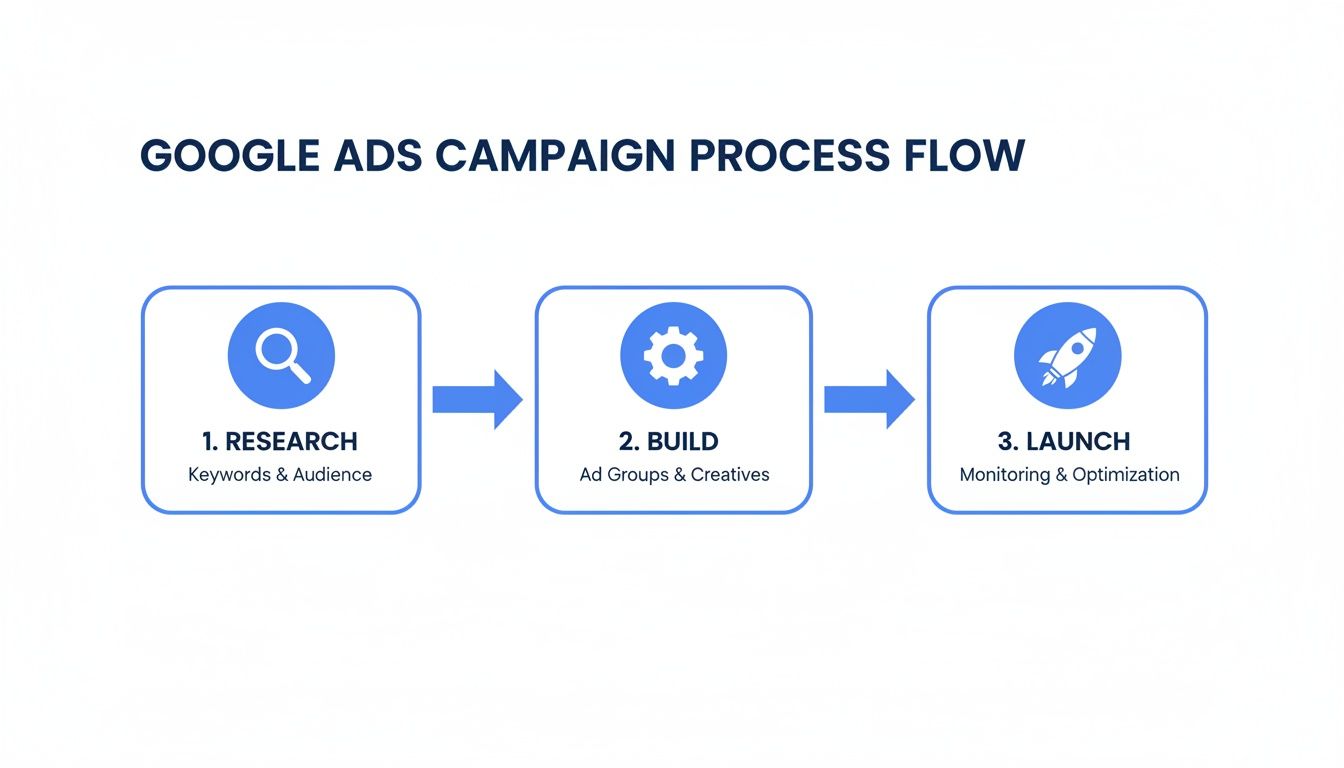
As illustrated, effective measurement begins with a solid foundation laid during the research and build phases.
Turning Data into Actionable Insights
Simply monitoring these KPIs is not enough. The real value comes from using this data to make informed optimizations. Is your CPL too high? It may be time to refine your keyword list with more negative keywords or test new ad copy. Is your conversion rate low? Perhaps your landing page needs A/B testing, or your lead form is too long.
By consistently analyzing this performance data, you can identify your top-performing campaigns, ad groups, and keywords, and strategically allocate your budget to what works best. This data-driven optimization process removes guesswork, enabling you to systematically improve results over time.
Solving the Speed-to-Lead Challenge in Your Workflow
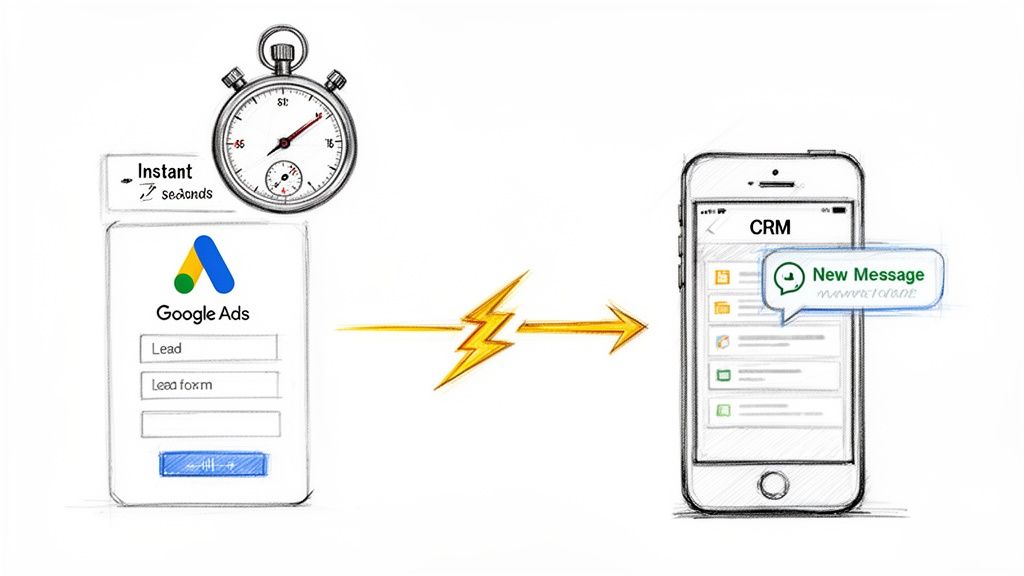
You've built a highly optimized Google Ads campaign, and the leads are flowing in. Congratulations. But now comes the most critical and often-overlooked part of the process: speed-to-lead. The time it takes for your team to follow up with a new lead is often the single most important factor in whether that lead becomes a customer or a lost opportunity.
When someone submits a form, their interest and intent are at an absolute peak. Their problem is top of mind, and they are actively seeking a solution. This window of opportunity is fleeting. Studies have shown that the odds of contacting a lead decrease by over 10 times in the first hour. If you wait, competitors get there first, and the initial urgency that prompted the search dissipates.
The Problem with Manual Lead Retrieval
For many businesses running Google Ads, the default process for handling new leads is a major bottleneck. It typically involves manually logging into the Google Ads platform, navigating to the correct campaign, and downloading a CSV file of new leads. This process is not just inefficient; it's a direct cause of lost revenue.
This manual retrieval creates a significant delay between a prospect expressing interest and your sales team engaging with them. In today's on-demand world, this gap is where potential deals are lost. Your team ends up following up on cold leads, and the ad spend you invested generates opportunities that lose their value before they can be acted upon.
The purpose of what is lead generation marketing is not just to collect data. It's to initiate a timely conversation. A lead sitting in a CSV file is a depreciating asset, its value diminishing with every passing minute.
Automating for an Instant Connection
The only effective solution to the speed-to-lead problem is automation. Tools like Pushmylead eliminate the manual download process entirely. They bridge the gap between lead submission and sales engagement, creating an instant connection. Instead of waiting for a manual export, the lead's details are instantly sent to your CRM, email inbox, or sales notification system the moment they hit "submit."
This single change can revolutionize your entire sales process. It empowers your sales team to connect with high-intent leads within moments, not hours. This immediate response transforms the first interaction from a cold follow-up to a timely and relevant conversation.
Here, you can see how an automated tool can instantly push a new lead from a Google Ads form to an email, ready for immediate action.
The power lies in providing actionable data in real-time. A salesperson receiving this notification on their mobile device can follow up while the prospect is still actively thinking about the solution they were searching for.
By solving the speed-to-lead challenge, you maximize the return on every dollar spent on Google Ads. You ensure that the interest you generate is met with immediate action, dramatically increasing your conversion rates and transforming your lead generation efforts into a true engine for business growth.
Got Questions? We've Got Answers
Even experienced advertisers have questions when deep in the trenches of a Google Ads lead generation campaign. Getting clear answers is key to optimizing performance. Here are some of the most common questions about lead generation within the Google Ads ecosystem.
Lead Generation vs. Demand Generation: What’s the Real Difference?
It's easy to confuse these two, but they represent two different stages of the marketing funnel.
Demand generation is about creating awareness and interest in your product or service category. It's top-of-funnel marketing. In Google Ads, this might be a YouTube awareness campaign or a Display campaign targeting broad affinity audiences. The goal is to make people aware a problem exists and that you are a potential solution.
Lead generation is about capturing the demand that already exists. It's a mid-to-bottom-of-funnel activity focused on converting interest into a contact. A Google Search campaign targeting high-intent keywords is pure lead generation—it targets users who are actively looking for a solution right now.
How Long Should My Google Ads Lead Form Be?
As short as humanly possible. Only ask for the absolute minimum information required to qualify and contact the lead.
Every additional field you add to your lead form increases friction and reduces your conversion rate. Simplicity and ease of completion are paramount.
Consider this framework:
- Top-of-Funnel Offers (e.g., webinar registration): Name and email is often sufficient.
- Bottom-of-Funnel Offers (e.g., quote or demo request): You can add one or two key qualifying fields, such as "Company Size" or "Primary Business Challenge," but only if they are essential for your sales process.
Always balance your need for data against the significant risk of the user abandoning the form.
Why Is Lead Quality So Much More Important Than Quantity?
Because one qualified lead that converts is infinitely more valuable than 100 unqualified leads that don't.
A high-quality lead fits your ideal customer profile, has a genuine need for your service, and has the authority to make a purchasing decision. Sending these to your sales team ensures that your ad spend is directly contributing to revenue. Conversely, flooding your sales team with low-quality leads wastes their time, lowers morale, and burns through your marketing budget inefficiently.
Focusing on lead quality results in a much higher return on investment (ROI) and creates a more efficient and effective sales pipeline.
How Can I Get Better Quality Leads From My Google Ads?
Improving lead quality is a multi-faceted process involving strategic refinement across your campaign.
First, tighten your keyword targeting. Use specific, long-tail keywords that signal strong commercial intent (e.g., "certified salesforce consultant for finance" vs. "salesforce help").
Second, be aggressive with your negative keyword list. Continuously add terms that indicate informational or irrelevant searches to filter out low-quality traffic.
Finally, use your ad copy and lead form to pre-qualify prospects. Be explicit about who your service is for and what it costs. This transparency helps ensure that only the most relevant users will click and convert.
Stop letting your best prospects go cold while you're busy with manual downloads. Pushmylead sends your Google Ads leads straight to your CRM or email the second they come in, so you can connect while you're still top-of-mind. Start your free trial today and turn that click into a conversation.