
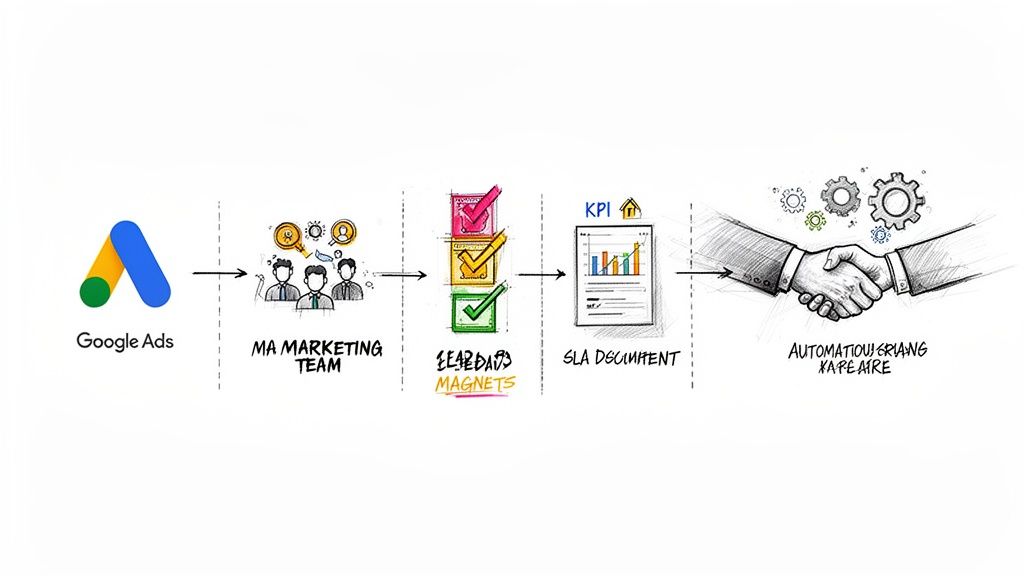
In the world of Google Ads, generating a lead is only half the battle. Clicks, impressions, and even lead form submissions are just vanity metrics if they don't convert into revenue. The real key to maximizing your Google Ads ROI lies in what happens after the click, which depends entirely on seamless collaboration between your marketing and sales teams. A disconnect here is one of the most common and costly mistakes an agency can make, directly impacting campaign performance and client retention.
When marketing and sales operate in silos, high-potential leads generated from Search, Performance Max, or YouTube campaigns fall through the cracks. Sales teams get frustrated with low-quality leads, while marketing struggles to prove the value of their ad spend. This friction leads to wasted budgets, missed revenue targets, and a cycle of blame that undermines growth. True success with Google Ads requires a unified approach where both teams are aligned on goals, definitions, and processes.
This article provides a blueprint for achieving that unity. We will dive into 10 crucial sales and marketing alignment best practices specifically tailored for the Google Ads ecosystem. You will get actionable data, proven tips, and clear strategies to build a cohesive system that turns high-quality clicks into closed deals. From establishing a Service Level Agreement (SLA) and implementing automated lead routing to creating closed-loop reporting that proves ad spend value, we'll show you how to ensure every dollar you invest in Google Ads works harder for your business. Let’s bridge the gap and transform your lead generation efforts into a predictable revenue engine.
1. Establish a Single Source of Truth for Lead Data
Discrepancies between what marketing generates and what sales receives are a primary source of misalignment. A single source of truth (SSoT) solves this by creating one unified system where both teams access the same real-time lead information. This eliminates data silos and ensures everyone works from an identical, up-to-date dataset, which is a cornerstone of effective sales and marketing alignment best practices.
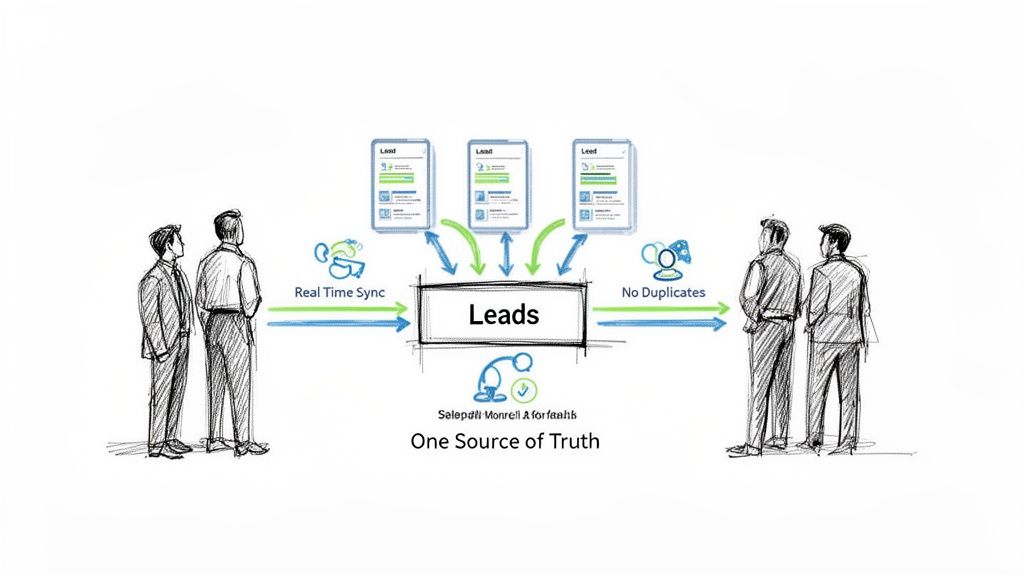
For agencies managing Google Ads campaigns, this is particularly critical. Leads from Search, Discovery, and YouTube campaigns arrive at different times and can quickly become stale if manually downloaded from spreadsheets. When a sales rep contacts a lead hours after they submitted a form, that lead's initial intent has often faded, leading to wasted effort and lost opportunities.
Why It's a Foundational Step
A shared data environment prevents the classic "your leads are bad" versus "you aren't working the leads" argument. When sales can see the exact time a lead came in from a Google Ads form and marketing can see the sales team's immediate follow-up attempts, accountability becomes clear. To truly establish a single source of truth for lead data, integrating a robust CRM with automation is indispensable, allowing both sales and marketing teams to operate from consistent, up-to-date information.
How to Implement It
- Integrate Google Ads with Your CRM: Connect your Google Ads account directly to your CRM (like HubSpot or Salesforce) to auto-populate new leads.
- Use Instant Lead Forwarding: For Google Ads lead form assets, manual downloads are too slow. Use a tool like Pushmylead to send lead data to your sales team's CRM or email inbox the moment a user hits "submit."
- Establish Data Hygiene Rules: Create clear protocols for who updates lead statuses and when. Implement automated data validation to ensure fields like phone numbers and email addresses are correctly formatted.
- Conduct Weekly Audits: Schedule brief weekly meetings to review the data flow, identify any discrepancies between Google Ads and your CRM, and resolve them quickly.
2. Define and Align on Lead Definition and Qualification Criteria (SLA)
One of the most common friction points between teams is a disagreement on lead quality. Marketing celebrates a high volume of leads from a Google Ads campaign, while sales complains they are unqualified. A Service Level Agreement (SLA) eliminates this ambiguity by creating a formal, documented contract between marketing and sales that defines exactly what constitutes a qualified lead and how it will be handled. This is a critical component of sales and marketing alignment best practices.
For agencies, an SLA is essential when running diverse Google Ads campaigns. A lead from a highly targeted Search campaign for "commercial HVAC repair" has different qualification criteria than a lead from a broader YouTube awareness campaign. The SLA ensures that marketing focuses on generating leads that sales has already agreed are worth pursuing, preventing wasted ad spend and sales effort.
Why It's a Foundational Step
An SLA transforms the subjective "this lead is bad" conversation into an objective, data-driven discussion. It sets clear expectations for both teams: marketing commits to delivering a certain number of qualified leads, and sales commits to a specific follow-up process and timeline. This mutual accountability builds trust and ensures that valuable leads captured via Google Ads lead form extensions are never neglected. It also provides a clear framework for measuring the true ROI of your campaigns.
How to Implement It
- Mutually Define MQL and SQL: Sit down with both teams to agree on the specific criteria for a Marketing Qualified Lead (MQL) and a Sales Qualified Lead (SQL). You can find more details on this by exploring what a Marketing Qualified Lead is and how to define it for your business.
- Establish Response Time Rules: Agree on a maximum time for sales to follow up with a new lead. For instant channels like Google Ads lead forms, this should be measured in minutes, not hours.
- Document Everything: Create a shared document (like a Google Doc) that outlines the full SLA, including lead definitions, hand-off procedures, and follow-up cadence. Ensure it is easily accessible to everyone.
- Schedule Quarterly Reviews: The market changes, and so do your campaigns. Revisit the SLA every quarter to analyze performance, review lead quality based on conversion data, and make necessary adjustments to the qualification criteria.
3. Implement Automated Lead Routing and Instant Notifications
Manual lead distribution is a bottleneck that directly undermines marketing ROI and frustrates sales teams. Automated lead routing and instant notifications solve this by using predefined rules to assign leads to the right salesperson the moment they are generated. This eliminates manual tasks, ensures no lead falls through the cracks, and dramatically improves response time, a critical factor for converting high-intent prospects.
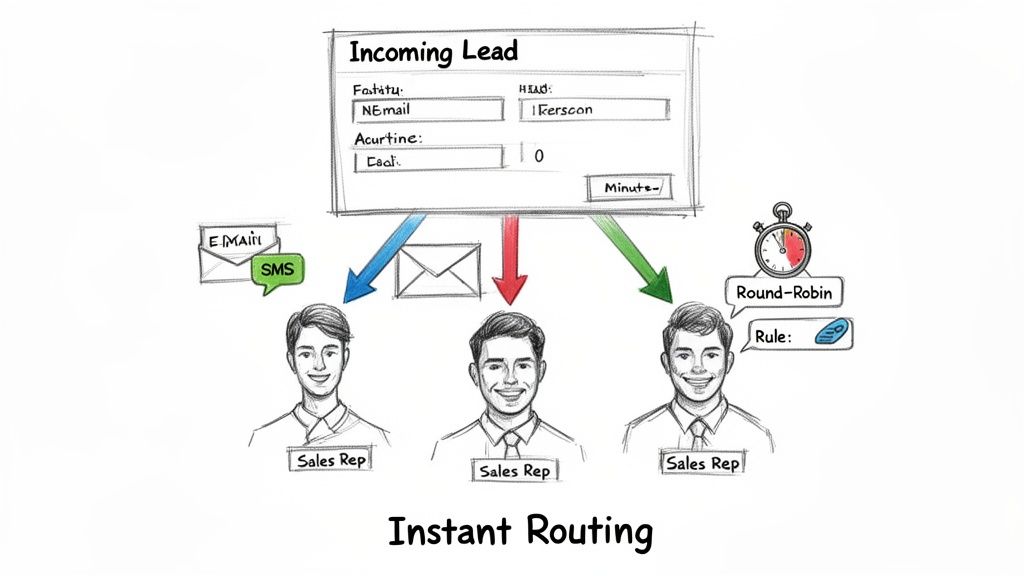
For agencies managing Google Ads campaigns, speed is non-negotiable. A lead from a lead form asset is at its peak intent right after submission. If that data sits in a spreadsheet waiting for manual assignment, its value plummets with each passing minute. Tools that immediately forward lead information from Google Ads to the sales team are essential components of modern sales and marketing alignment best practices.
Why It's a Foundational Step
Automating lead handoffs prevents "lead leakage" and ensures equitable distribution, holding both teams accountable to the SLA. When a hot lead from a high-performing Google Ads campaign is instantly routed to the best-equipped sales rep with a notification, the chances of conversion skyrocket. This system transforms the handoff from a potential point of failure into a seamless, efficient, and measurable process.
How to Implement It
- Use Instant Forwarding for Google Ads: Implement a tool like Pushmylead to send lead form submissions from your campaigns directly to sales inboxes or CRM systems in real-time. This bypasses the slow, manual process of downloading CSV files.
- Create Data-Driven Assignment Rules: Don't just route leads based on geography. Analyze performance data to assign leads based on which representative has the highest conversion rate for specific campaign types (e.g., Search vs. YouTube) or keywords.
- Enrich Notifications with Context: Configure your instant alerts (via email, Slack, or SMS) to include key details from the lead form, such as the campaign source, ad group, and any specific user inputs. This allows sales to tailor their initial outreach effectively.
- Test and Refine Routing Logic: Before full deployment, run tests with sample leads to ensure your routing logic works as expected. Regularly review and adjust the rules based on sales performance and feedback to optimize the system.
4. Create Closed-Loop Reporting and Attribution Tracking
To achieve true alignment, marketing needs to see what happens after a lead is passed to sales. Closed-loop reporting establishes a feedback system where every lead from a marketing campaign is tracked through the entire sales cycle, ultimately revealing which specific efforts generated actual revenue. This moves beyond vanity metrics like clicks and conversions to focus on the ultimate goal: bottom-line impact.
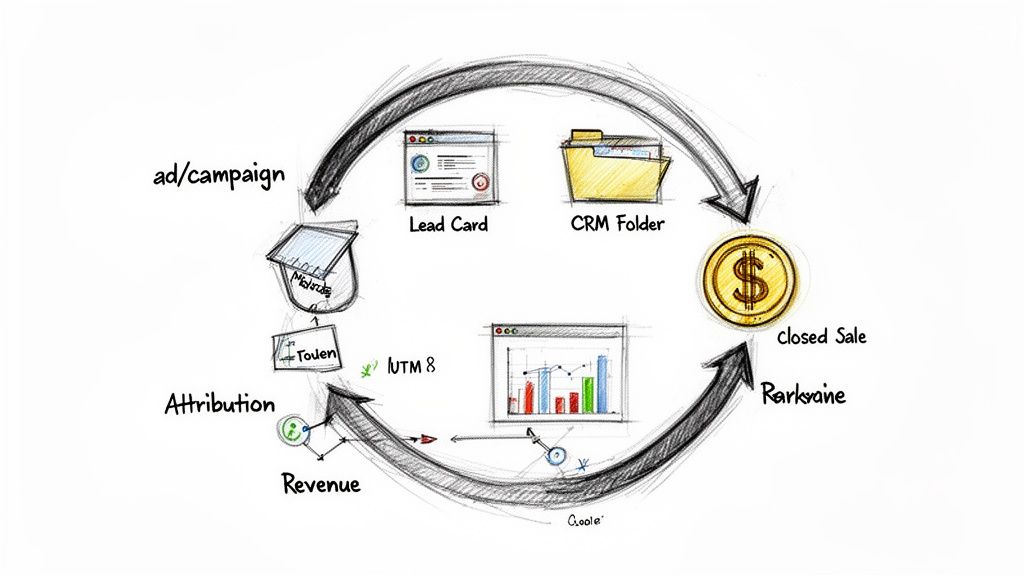
For Google Ads agencies, this is the key to proving ROI. By tracking a lead from a specific ad group or keyword all the way to a closed-won deal in the CRM, you can definitively show a client which parts of their budget are driving sales, not just form submissions. It allows you to optimize campaigns based on revenue, not just lead volume, which is a powerful differentiator.
Why It's a Foundational Step
Closed-loop reporting ends debates over lead quality by providing objective, revenue-based data. When both teams see that a particular Google Ads campaign generated five high-value customers, there's no question about its effectiveness. This data-driven approach fosters mutual respect and provides the insights needed for smarter budget allocation, making it an essential component of sales and marketing alignment best practices.
How to Implement It
- Implement UTM Parameters: Use UTM parameters on all your Google Ads destination URLs to tag leads with their source, campaign, and keyword. This data should be captured in hidden fields on your lead forms and passed to the CRM.
- Integrate Offline Conversion Tracking: Connect your CRM with Google Ads to import conversion data. This allows you to attribute closed deals back to the specific clicks and campaigns that originated them.
- Standardize CRM Lead Statuses: Define clear, consistent stages in your CRM (e.g., New, Contacted, Qualified, Proposal, Won, Lost) that both teams agree on and use.
- Create a Shared Dashboard: Build a monthly report or dashboard that visualizes the entire funnel, from Google Ads campaign spend to the revenue generated. Celebrate wins together when the data shows marketing's direct contribution to sales.
5. Establish Regular Cadence Meetings and Communication Protocols
Data and systems are only part of the solution; human interaction is where alignment truly solidifies. Regular cadence meetings create a dedicated forum for sales and marketing to discuss what’s working, what isn't, and why. By establishing clear communication protocols, teams can resolve issues collaboratively instead of letting frustrations build up in silos, which is a key component of successful sales and marketing alignment best practices.
For agencies running Google Ads campaigns, this structured communication is vital. Feedback from the sales team on lead quality from a new Performance Max campaign can inform marketing's creative and audience targeting optimizations in near real-time. Without a dedicated meeting, this crucial insight might take weeks to surface, resulting in wasted ad spend and missed revenue opportunities.
Why It's a Foundational Step
Structured communication prevents misalignment from festering. When a sales team feels that leads from a new YouTube Ads campaign are unqualified, a regular meeting provides a constructive space to share specific examples and discuss solutions. It transforms subjective complaints into objective problem-solving. Marketing can then explain the targeting strategy, and both teams can collaborate on refining the ad copy or landing page offer to attract higher-intent prospects.
This direct feedback loop ensures that marketing efforts remain closely tied to sales outcomes, making both teams more effective and accountable. It moves the conversation beyond spreadsheets and into the practical realities of converting leads into customers.
How to Implement It
- Schedule Bi-Weekly Syncs: Book a recurring 30-minute meeting every two weeks with leadership from both sales and marketing.
- Use a Shared Metrics Dashboard: Base discussions around a shared dashboard (like Google Data Studio) that pulls in Google Ads CPL, sales pipeline velocity, and close rates. This keeps the conversation focused on data.
- Discuss Specific Leads: Move beyond high-level metrics. Ask sales to bring examples of both high-quality and low-quality leads from recent campaigns to discuss what made them good or bad.
- Establish a Feedback Channel: Create a dedicated Slack channel or a simple form for sales to provide immediate, blame-free feedback on lead quality. This allows for quick adjustments between formal meetings.
- Rotate Meeting Leadership: Alternate who runs the meeting between sales and marketing leaders each session. This fosters a sense of shared ownership over the alignment process and its outcomes.
6. Align on Campaign and Messaging Strategy Based on Buyer Personas
Misaligned messaging is a silent killer of ROI. When marketing creates campaigns based on one ideal customer profile and sales pursues another, resources are wasted, and leads fail to convert. True alignment requires both teams to jointly develop, approve, and build strategies around specific buyer personas. This ensures every piece of ad copy, landing page, and lead form question is designed to attract and qualify the exact prospects the sales team is equipped to close.
For agencies running Google Ads, this collaborative approach is non-negotiable. It's the difference between generating a high volume of low-quality clicks and attracting a steady stream of high-intent prospects who match the ideal customer profile. When marketing and sales agree on the target persona, campaigns become laser-focused, improving lead quality and making the sales process far more efficient.
Why It's a Foundational Step
Jointly developed buyer personas serve as the strategic compass for all acquisition efforts. They prevent the common scenario where marketing celebrates a high conversion volume from a Google Ads campaign, only for sales to report that none of the leads are qualified. This practice transforms marketing from a lead generation factory into a strategic partner that delivers sales-ready opportunities, making it a cornerstone of effective sales and marketing alignment best practices.
How to Implement It
- Co-Create Persona Documents: Schedule workshops with sales team members to define and document key buyer personas. Discuss their pain points, goals, job titles, and the language that resonates most with them.
- Tailor Google Ads Campaigns: Create separate ad groups or even entire campaigns targeting each specific persona. For a SaaS client, this could mean one campaign for "CFOs" focused on ROI and another for "IT Directors" focused on security and integration.
- Customize Lead Form Questions: Use persona insights to ask relevant qualifying questions in your Google Ads lead forms. For an enterprise software vendor, a form for a CEO persona might ask about strategic goals, while a form for an IT manager might ask about existing tech stack.
- Conduct Quarterly Persona Reviews: Revisit and refine your buyer personas every quarter with the sales team. Use real customer data and sales feedback to ensure they remain accurate and relevant to market changes.
7. Implement Lead Scoring to Prioritize Sales Effort
Not all leads are created equal. A lead scoring system assigns points to each lead based on specific attributes and behaviors, allowing sales to focus their time on the prospects most likely to convert. By developing this model jointly, marketing understands what drives a high-quality lead, and sales trusts the prioritization, making this one of the most impactful sales and marketing alignment best practices.
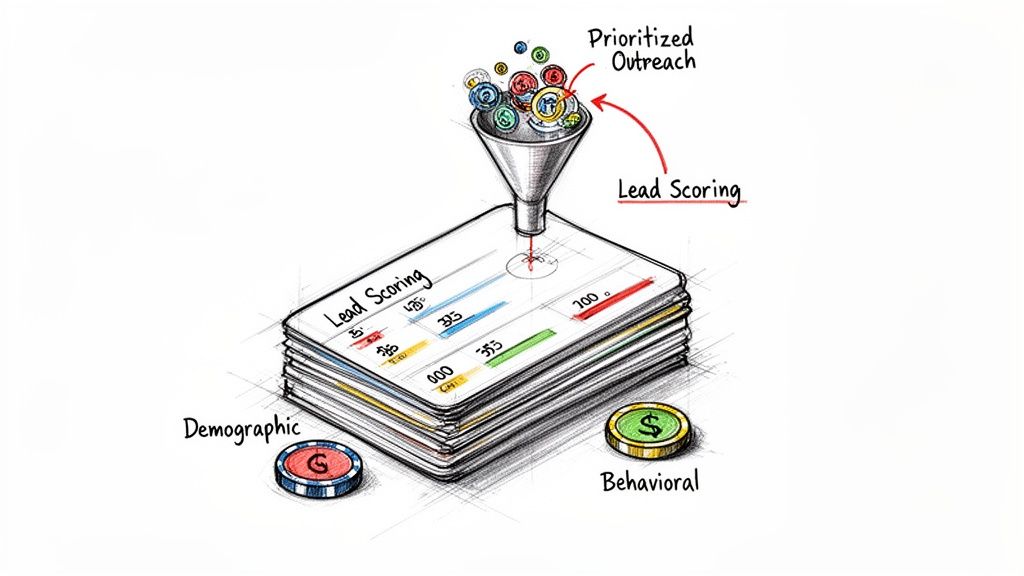
For agencies running Google Ads, this is crucial. A lead who downloads a "Beginner's Guide to PPC" is very different from one who requests a "Custom Google Ads Account Audit." Lead scoring quantifies that difference, ensuring the high-intent lead gets immediate attention while the other is nurtured by marketing until they display more buying signals.
Why It's a Foundational Step
A shared lead scoring model moves the conversation from subjective opinions to data-driven facts. It answers the question, "What is a good lead?" with a number that both teams agree upon. When sales sees a lead with a high score, they know it has met specific demographic and engagement criteria, such as company size and recent website activity, making them more motivated to follow up quickly.
How to Implement It
- Define Scoring Criteria Together: In a joint session, list the key attributes of your ideal customer. Assign points for explicit data like job title, industry, and company revenue, as well as implicit data like pages visited or content downloaded.
- Analyze Historical Data: Review your past closed-won deals. What did those customers have in common? Use these patterns to build a predictive scoring model based on real success.
- Implement Point Decay: A lead's score should decrease over time if they show no engagement. This keeps the sales queue fresh and focused on active prospects.
- Integrate Scoring with Automation: Use your CRM to automatically route leads that reach a certain score threshold. For instance, once a lead from a Google Ads campaign hits a score of 75, it can be instantly assigned to a sales rep for immediate outreach.
8. Create Feedback Loops and a Lead Quality Management Process
A common disconnect happens when marketing passes leads to sales without knowing what happens next. A formal feedback loop closes this gap by creating a structured process for sales to report on lead quality directly back to marketing. This bidirectional communication ensures marketing isn't optimizing for vanity metrics like lead volume, but for metrics that actually drive revenue. This process is a critical component of successful sales and marketing alignment best practices.
Without feedback, a Google Ads agency might scale a campaign that generates hundreds of form fills, only to find out weeks later that none converted because they attracted the wrong audience. A real-time feedback system prevents this waste by allowing for rapid adjustments to targeting, ad copy, and keyword strategy based on frontline sales intelligence.
Why It’s a Foundational Step
This process transforms the relationship from one of blame to one of collaboration. When sales can flag a lead from a Google Ads campaign as "unqualified-wrong industry" and marketing can immediately see that feedback, the focus shifts to solving the targeting issue together. It provides marketing with the qualitative data needed to refine campaigns, ensuring the ad spend is directed toward attracting the most valuable prospects.
How to Implement It
- Establish Simple Feedback Fields in the CRM: Add a mandatory dropdown or text field in your CRM for sales to categorize leads (e.g., Unqualified-Wrong Role, Spam, Not Interested, Follow-Up Later).
- Automate Feedback Capture: Use tools that allow sales reps to provide feedback the moment they engage with a lead. For instance, when a lead from a Google Ads campaign is delivered, the system can prompt the sales rep for an immediate quality rating.
- Schedule Monthly Feedback Reviews: Dedicate time each month for marketing and sales leaders to review a feedback dashboard. Identify the top reasons for lead rejection and brainstorm solutions, such as adding negative keywords or refining audience demographics in Google Ads.
- Celebrate Quality Improvements: When sales feedback leads to a campaign adjustment that increases lead quality, share the win with both teams. This reinforces the value of the feedback loop and encourages continued participation from the sales team.
9. Develop Transparent Budget and Resource Allocation Process
Conflicts over lead volume and quality often stem from a disconnect between marketing spend and sales capacity. A transparent budget and resource allocation process ensures both teams agree on how funds are used to generate leads. Sales gains visibility into the investment required for campaigns, while marketing understands the sales team's capacity to handle the resulting leads, making this one of the most practical sales and marketing alignment best practices.
This clarity is vital for agencies managing Google Ads budgets. When a client questions why lead volume dropped, marketing can point to a joint decision to reallocate funds from a high-volume, low-quality Discovery campaign to a lower-volume, higher-quality Search campaign. This shared understanding prevents finger-pointing and aligns expectations with financial reality.
Why It's a Foundational Step
A transparent budget process shifts conversations from emotional arguments ("we need more leads!") to data-driven decisions ("to get 20 more qualified leads, we need to increase the Google Ads budget by 15%"). When sales understands that every lead from a Google Ads campaign has a specific cost, they become more invested in the lead's success. It fosters mutual respect for each team's constraints and contributions, building a true partnership.
How to Implement It
- Calculate Key Metrics Together: Start by jointly calculating the cost-per-lead (CPL) and cost-per-acquisition (CPA) for each channel, especially different Google Ads campaign types like Search, P-Max, and YouTube.
- Align Budget to Sales Capacity: Have an explicit conversation: "How many high-intent leads can the sales team realistically follow up on per week?" Use this number to set lead generation targets and allocate the Google Ads budget accordingly.
- Set Shared ROI Goals: Instead of separate targets, create unified goals. For example, agree that any Google Ads campaign must deliver a customer acquisition cost under a specific threshold, ensuring marketing's spend directly supports sales' revenue targets.
- Conduct Quarterly Budget Reviews: Meet every quarter to review performance data. If YouTube leads are converting at a higher rate than Display leads, collaboratively decide to reallocate the budget and document the strategic reason for the shift.
10. Create Onboarding and Training Program to Embed Alignment Culture
Sales and marketing alignment should be an integral part of your company culture, not an initiative that fades when key personnel leave. A formal onboarding and training program embeds this alignment from day one, ensuring every new hire understands their role within a unified revenue team. This program makes collaboration the default setting by teaching shared goals, metrics, and processes from the outset.
For agencies managing Google Ads campaigns, this means training new marketers on what makes a lead valuable to sales and training new salespeople on the strategy behind the campaigns generating those leads. When a new sales hire understands the cost-per-lead and targeting strategy of a Google Ads campaign, they are more likely to value and diligently work every lead that comes through.
Why It's a Foundational Step
An alignment-focused onboarding program prevents siloed thinking before it can start. It institutionalizes the processes, SLAs, and shared KPIs you have established, turning them from abstract rules into tangible daily practices. This proactive approach ensures that the principles of sales and marketing alignment best practices are woven into the fabric of your team's operations, creating a sustainable, collaborative culture.
How to Implement It
- Co-Teach Onboarding Sessions: Have the VP of Sales and VP of Marketing jointly lead a session for all new hires, explaining the shared revenue goals and the importance of their partnership.
- Mandate Cross-Functional Shadowing: Require new marketing team members to shadow sales calls during their first month to hear customer objections and needs firsthand. Conversely, have new sales reps sit in on marketing strategy sessions to understand campaign planning.
- Document Everything: Create a digital resource library with all shared documents, including the SLA, lead scoring criteria, and MQL/SQL definitions. This becomes a go-to reference for new and existing team members. For practical insights into how streamlined enablement programs can significantly boost sales readiness and performance, especially in new industries, refer to case studies like those detailing accelerating sales readiness and performance through streamlined enablement.
- Train on the Tech Stack: Ensure all new hires are trained on the integrated CRM and tools like your instant lead-forwarding system. Show them how a lead travels from a Google Ads form to their dashboard in real time and explain why that speed is critical for conversion.
10-Point Sales & Marketing Alignment Best Practices Comparison
| Approach | 🔄 Implementation complexity | Resources required | ⚡ Speed / Efficiency | ⭐ Expected outcomes / 📊 Impact | Ideal use cases & 💡 Key advantages |
|---|---|---|---|---|---|
| Establish a Single Source of Truth for Lead Data | Medium–High — integrations + governance | CRM, integration middleware, data governance, vendor tools | High — real-time sync reduces delays | High accuracy, fewer duplicates, faster responses (⭐⭐⭐⭐) | Agencies managing multi-source lead forms; use Pushmylead, schedule audits |
| Define and Align on Lead Definition and Qualification Criteria (SLA) | Medium — policy workshops and documentation | Time from sales & marketing, docs, measurement tools | Moderate — speeds handoffs by clarity | Fewer disputes, improved lead fit (⭐⭐⭐⭐) | B2B/agency environments; use form fields for qualification, review quarterly |
| Implement Automated Lead Routing and Instant Notifications | High — routing logic and integrations | Automation platform, CRM, SMS/email channels, testing resources | Very high — minutes-to-contact improvements (⚡⚡⚡) | Dramatic conversion uplift from faster contact (⭐⭐⭐⭐⭐) | High-volume campaigns; use Pushmylead, test rules and notification channels |
| Create Closed-Loop Reporting and Attribution Tracking | High — cross-system tracking and attribution models | CRM, analytics, UTMs, dashboards, data engineers | Low direct speed impact — improves decision speed | Clear ROI, budget optimization, better channel decisions (⭐⭐⭐⭐) | Advertisers needing revenue attribution; implement UTMs and CRM integration |
| Establish Regular Cadence Meetings and Communication Protocols | Low — scheduling and agenda setting | Time commitment, shared dashboards, meeting facilitation | Moderate — faster issue resolution | Better transparency, quicker course corrections (⭐⭐⭐) | All teams; rotate leadership, use action items and shared metrics |
| Align on Campaign and Messaging Strategy Based on Buyer Personas | Medium — research and content alignment | Persona research, sales interviews, creative/testing budget | Moderate — reduces time wasted on wrong prospects | Higher-quality leads and improved conversions (⭐⭐⭐⭐) | Persona-driven campaigns (SaaS, B2B); test messaging, separate forms per persona |
| Implement Lead Scoring to Prioritize Sales Effort | Medium–High — modeling and data integration | Analytics, historical data, scoring engine, ongoing tuning | High — focuses sales on highest-probability leads | Better prioritization and higher close rates (⭐⭐⭐⭐) | Teams needing prioritization; start simple, refine monthly, include decay |
| Create Feedback Loops and Lead Quality Management Process | Medium — process design and discipline | Simple feedback forms, dashboarding, regular reviews | Moderate — continuous quality gains over time | Continuous improvement in lead quality (⭐⭐⭐) | Agencies with iterative campaigns; keep feedback simple, track rejection reasons |
| Develop Transparent Budget and Resource Allocation Process | Medium — cross-functional budgeting process | Performance data, budgeting tools, stakeholder time | Moderate — aligns capacity with spend | Improved ROI and balanced workload (⭐⭐⭐) | Clients/agencies optimizing channels; calculate CPL, set capacity limits, review quarterly |
| Create Onboarding and Training Program to Embed Alignment Culture | Medium — curriculum and mentoring setup | Training content, leader time, shadowing programs | Low immediate speed impact — high long-term effect | Sustained alignment and faster ramp-up (⭐⭐⭐) | Growing teams/agencies; co-teach by VPs, require cross-team shadowing, document processes |
From Clicks to Customers: Turning Alignment into Your Competitive Advantage
The journey from a promising Google Ads click to a closed deal is rarely a straight line. It’s a complex handoff, a relay race where a dropped baton means a lost opportunity and wasted ad spend. Throughout this guide, we've broken down the essential components of a high-performance engine: one where your marketing and sales teams operate not as separate functions, but as a unified revenue-generating force. These aren't just abstract theories; they are the tangible sales and marketing alignment best practices that top-performing agencies and advertisers use to dominate their markets.
We moved beyond surface-level advice to provide a blueprint for real-world application. From establishing a single source of truth for your lead data to creating a detailed Service Level Agreement (SLA), each practice is a critical gear in your growth machine. The goal is to eliminate the friction that silently kills your ROI-the lag time, the miscommunications, and the "us vs. them" mentality that plague so many organizations. True alignment means sales trusts the quality of leads from marketing, and marketing has clear, data-driven insights into which campaigns, keywords, and ad groups are actually driving revenue.
Your Blueprint for Actionable Alignment
Instead of feeling overwhelmed by a ten-point checklist, view these strategies as a strategic roadmap. Your first step isn't to implement everything at once. It's to identify the single biggest point of friction in your current process and start there.
- Is lead speed your biggest bottleneck? If your Google Ads leads are sitting in an inbox for hours, focus on implementing automated lead routing and instant notifications. This is a quick win that delivers an immediate impact on conversion rates.
- Is lead quality the constant debate? Start by collaboratively defining your lead qualification criteria and building a robust lead scoring model. This ensures sales spends time on the opportunities most likely to close.
- Are you flying blind on ROI? Prioritize closed-loop reporting. Connecting your Google Ads data directly to CRM outcomes is the only way to prove the value of your marketing efforts and make smarter budget decisions.
The core principle is simple: every click you pay for on Google Ads deserves the best possible chance to become a customer. This is only possible when the entire journey, from ad impression to sales conversation, is seamless, measured, and optimized. Adopting these sales and marketing alignment best practices transforms your Google Ads strategy from a simple lead generation tactic into a predictable and scalable revenue pipeline. It’s the ultimate competitive advantage, allowing you to maximize the value of every single dollar you invest in advertising. The path forward is clear: choose a starting point, secure an early victory, and build unstoppable momentum.
Ready to eliminate the critical delay between a lead submission and sales follow-up? Pushmylead delivers your Google Ads leads to your sales team's preferred channels in seconds, ensuring you connect with prospects at the moment of peak interest. Stop losing your hottest leads to speed and start converting more clicks into customers by visiting Pushmylead today.