

Responsive Search Ads, or RSAs, are Google's AI-driven solution to the age-old advertising challenge: writing one perfect ad for thousands of different people. This dynamic ad format within the Google Ads ecosystem mixes and matches different headlines and descriptions you provide in real-time. The goal is to automatically figure out and show the best possible message for each individual search, maximizing relevance and performance.
What Are Responsive Search Ads Anyway?
Think of RSAs this way: instead of writing one single, rigid ad, you give Google Ads a pool of creative “ingredients.” You supply up to 15 different headlines and 4 descriptions, and Google’s machine learning gets to work.
It acts like a super-smart creative director, testing countless combinations on the fly. For one person’s search, it might combine Headline A with Description B. For the next, it might use Headlines C, E, and A with Description D. This constant, automated testing allows Google to serve up an ad that feels incredibly relevant to what each person is looking for right at that moment.
The Shift from Static to Dynamic Ads in Google Ads
This is a huge leap from how search advertising used to be done. For years, advertisers relied on Expanded Text Ads (ETAs), which were static. You wrote your headlines and descriptions, and that was the ad everyone saw, period. While predictable, ETAs just couldn't keep up with the millions of unique ways people search every day.
In June 2022, Google officially sunsetted ETAs, making RSAs the new standard for search campaigns. This wasn't just a small tweak; it was a fundamental change in how we approach Google Ads. In fact, Google’s own data showed that advertisers who switched from ETAs to RSAs using the same creative assets saw an average of 7% more conversions at a similar cost. You can get more details on how RSAs outperform their predecessors and learn about other best practices.
This move cemented the industry's shift toward automation and machine learning. You provide the creative building blocks, and you let Google's algorithm do the heavy lifting to find the winning combinations. It saves a ton of time and, more often than not, gets better results.
Expanded Text Ads vs Responsive Search Ads At a Glance
To really see the difference, it helps to put the old and new formats side-by-side. The table below breaks down the key distinctions between the legacy ETAs and today's RSAs within the Google Ads platform.
| Feature | Expanded Text Ads (Legacy) | Responsive Search Ads (Current) |
|---|---|---|
| Headlines | Up to 3 fixed headlines in a specific order. | Up to 15 headlines that can be mixed and matched by Google. |
| Descriptions | Up to 2 fixed descriptions in a specific order. | Up to 4 descriptions that can be tested in different combinations. |
| Flexibility | Rigid. The ad you write is the ad that shows. | Highly flexible. Ad content adapts to the user's search query. |
| Optimization | Manual. You had to create and test multiple ad variations yourself. | Automated. Google’s AI continuously tests and optimizes combinations. |
| Ad Creation | Required creating many distinct ads to test different messaging. | Requires writing many high-quality "assets" (headlines/descriptions). |
| Performance | Performance was tied to a single, static ad copy. | Performance improves over time as the system learns what works best. |
As you can see, the core idea shifted from creating complete, finished ads to supplying a versatile set of components that an algorithm can assemble for you.
Core Benefits of Using RSAs
So, what does this all mean for your Google Ads campaigns? The big win with RSAs is their incredible adaptability. When you provide up to 15 headlines and 4 descriptions, you're giving the system a ton of creative firepower. This leads to some major advantages:
- Better Relevance: Your ads can more closely mirror what people are actually typing into the search bar, which almost always leads to higher click-through rates.
- Wider Reach: With so many possible combinations, your ads become eligible to compete in more auctions and show up for a broader range of relevant searches.
- Smarter Performance: Google is constantly running A/B tests in the background to find the best-performing combinations, automatically optimizing your campaigns for more clicks and conversions over time.
How Google AI Uses Your Ads in the Auction
To really get the hang of responsive search ads, it helps to pull back the curtain and see what Google's system is actually doing. Many advertisers think the Google Ads auction is just about who bids the most, but that’s not even half the story.
The whole game is decided by a metric called Ad Rank. This score determines where (or even if) your ad shows up. While your bid is part of the calculation, the quality and relevance of your ad are just as critical. This is where your RSA copy becomes your secret weapon.
The AI-Powered Ad Assembly Line
The moment someone hits "enter" on a search, Google's AI springs into action. It instantly rifles through all the ad components you've provided—up to 15 headlines and 4 descriptions. Its mission is to stitch together the perfect combination that best matches that person's search, what they're looking for, and even the device they're on.
Think of it like giving a master chef a pantry full of ingredients. You supply the ingredients (your headlines and descriptions), and the chef (Google’s AI) figures out the perfect recipe for each individual guest (the searcher) on the fly.
For one search, the AI might serve up a headline about "Free Shipping" with a description on "24/7 Support." For someone else searching with more specific terms, it might prioritize a headline that uses their exact keyword.
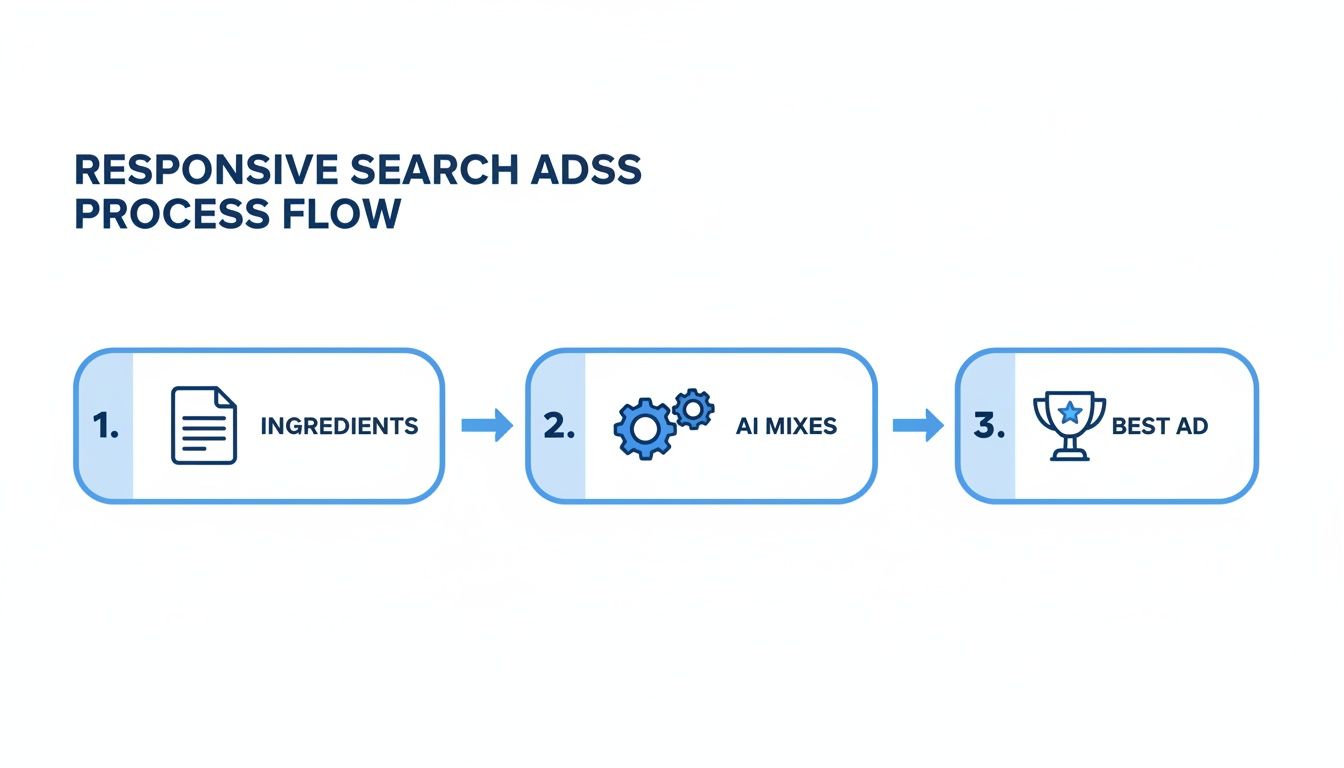
This powerful, real-time ad building is driven by some seriously advanced technology. The algorithms are constantly evolving, with recent news focusing on models like Gemini which enhance the system's ability to understand context and user intent. To get a sense of the engine under the hood, it’s worth understanding Google Gemini and its multimodal AI features.
The bottom line: A high-quality, super-relevant ad can actually beat a competitor with a higher bid. Your ad copy isn't just creative flair; it's a direct input that can help you win better spots for less money.
How Quality Assets Tip the Scales
Google's machine learning is smart, but it's not a mind reader. It can only work with the ingredients you provide. If you feed it distinct, compelling, and genuinely relevant headlines and descriptions, you're giving the AI much better material to work with.
When you do this well, good things start to happen in your Google Ads account:
- Better Ad Rank: More relevant ad combinations improve your Quality Score, which directly boosts your Ad Rank.
- Higher Click-Through Rates (CTR): Ads that feel like they were written specifically for the searcher get more clicks. Simple as that.
- Lower Cost Per Click (CPC): A strong Ad Rank often means you pay less than your competitors for a top spot.
So, the time you spend writing great ad components isn't just busywork. You're directly fueling the AI that decides whether you win or lose in the auction. It’s a partnership between your creative strategy and Google’s algorithm, and that's the core of modern search advertising.
Writing Headlines and Descriptions That Convert
Now that we've peeked behind the curtain at how the Google auction works, let's get to the fun part: writing the headlines and descriptions that fuel your responsive search ads. This is where your creativity meets Google's machine learning. The goal isn't to write one single, perfect ad anymore. It’s about giving the system a diverse toolkit of compelling messages it can assemble into a winner.
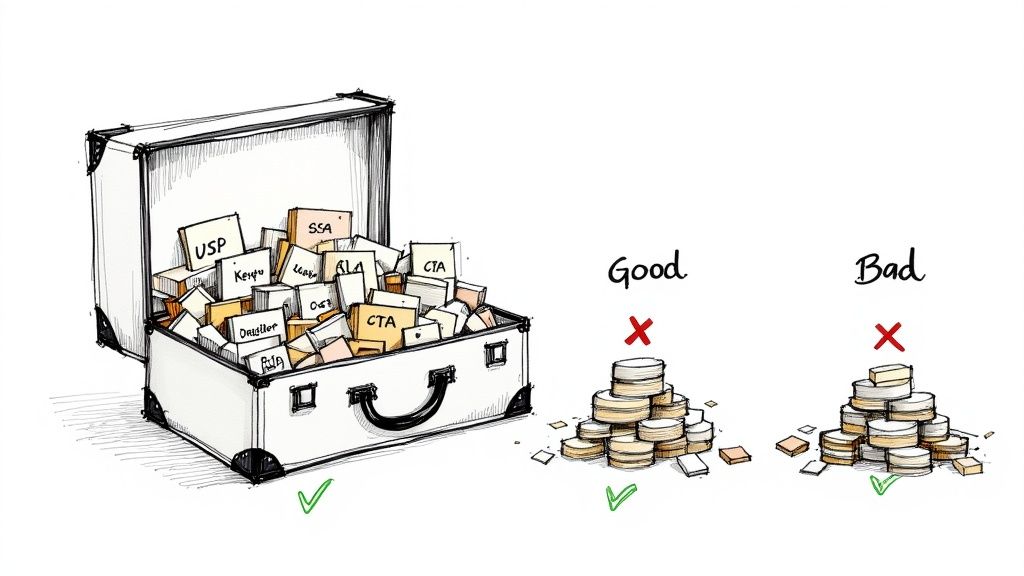
Think of it like packing a suitcase for a trip where the weather is a total mystery. You wouldn't just throw in fifteen of the exact same t-shirt, right? You'd pack a mix: short-sleeves, long-sleeves, a sweater, maybe a light jacket. Each piece gives you an option for whatever the day throws at you. Your ad headlines and descriptions work exactly the same way—each one needs to be distinct to give Google’s AI real choices.
Crafting a Versatile Mix of Headlines
Your mission is to fill as many of those 15 headline slots as you can with unique, non-repetitive copy. Every single headline is a potential hook, so variety is everything.
The best way to do this is to think in categories. A balanced set of headlines covers all the bases and appeals to different user mindsets. Try this approach:
- Keyword-Focused: Include your core keywords to show immediate relevance. (e.g., "Professional SEO Services")
- Benefit-Oriented: Answer the user's question: "What's in it for me?" (e.g., "Rank Higher on Google Search")
- Feature-Specific: Call out something specific about what you offer. (e.g., "Get a Dedicated SEO Expert")
- Call-to-Action (CTA): Tell people what you want them to do. (e.g., "Request Your Free SEO Audit")
- Social Proof: Build instant trust with stats or testimonials. (e.g., "Trusted by Over 500 Businesses")
Following a structure like this ensures you're feeding the algorithm a rich buffet of messages to test, not just the same meal over and over.
The Power of Distinct Descriptions
The same "variety is key" principle applies to your four description slots. Don't just rephrase the same point four times. Each description is your chance to expand on an idea or hit a different emotional trigger.
Use them to tell a more complete story:
- Description 1: Go deep on your Unique Selling Proposition (USP). What makes you the best choice?
- Description 2: Speak directly to a common customer pain point and position your service as the solution.
- Description 3: Highlight a specific offer, a money-back guarantee, or a standout feature.
- Description 4: Wrap it up with a strong, benefit-focused call to action.
With tight character limits on everything, mastering concise writing is a superpower. Every letter counts when you’re trying to pack a punch and get that click.
The Human Touch Still Wins
For all the talk of AI, don't forget that a real person with real experience is still your biggest asset. In a recent head-to-head analysis, human-written copy consistently outperformed AI-generated responsive search ads.
The difference was staggering in B2B campaigns, where human copy drove 289% higher lead value. For local service businesses, ads written by people produced 334% higher phone call conversion rates. This proves that nuanced, empathetic messaging connects in a way that algorithms just can't replicate yet.
This data is a powerful reminder: AI assembles the ad, but the quality of the human-written ingredients determines whether it’s a masterpiece or a flop. If you want to sharpen your skills here, check out our guide on the best ad copywriting techniques.
Good vs. Bad Examples of Ad Assets
Let's make this real. Imagine we're running ads for an online shoe store. Here’s what not to do.
BAD EXAMPLE: Repetitive and Vague
- Headline 1: Buy Shoes Online
- Headline 2: Online Shoe Store
- Headline 3: Shop for Shoes Here
- Description 1: We sell great shoes online for men and women. Check out our selection of shoes.
See the problem? These are all basically saying the same thing. Google's AI has nothing to work with here, which means you'll get bland, low-performing ads.
Now, let's see how an expert would do it.
GOOD EXAMPLE: Diverse and Specific
- Headline 1: Premium Leather Shoes
- Headline 2: Free Shipping On All Orders
- Headline 3: 100-Day Money-Back Guarantee
- Headline 4: Rated 4.9 Stars by Customers
- Headline 5: Shop Our New Fall Collection
- Description 1: Handcrafted for comfort that lasts all day. Find your perfect pair of dress shoes, boots, or sneakers.
- Description 2: Experience the difference quality makes. Shop now and get free, fast delivery right to your door.
This version is packed with value. It gives the system keywords, benefits, trust signals, and clear instructions. It’s like handing a master chef a pantry full of amazing ingredients—they have everything they need to create something truly persuasive for any customer.
Using Pinning and Ad Strength Strategically
To really get the most out of your responsive search ads, you need to get comfortable with two features that trip up a lot of advertisers: pinning and Ad Strength. Think of them as the advanced controls in your campaign’s cockpit. When you know how to use them, you get incredible precision. But if you misuse them, you can seriously limit your performance.
Let’s start with pinning. This feature lets you lock a specific headline or description into a certain position. For example, if you pin a headline to Position 1, Google is forced to show that exact headline first every single time your ad appears.
This gives you a level of control that can be absolutely essential in some situations. But, and this is a big but, it's a tool you have to use with caution because it directly ties the hands of Google's algorithm, preventing it from testing and learning.
The Strategic Use of Pinning
Pinning isn't something you should do on a whim. It's reserved for those non-negotiable messages that absolutely, positively must appear in a specific spot—whether for legal, branding, or key promotional reasons. It’s like telling a master chef, "No matter what amazing dish you create, this one specific ingredient has to be the centerpiece."
So, when does it make sense? Use pinning sparingly for things like:
- Brand Names: To make sure your company name is always the first thing people see (e.g., pinning "Pushmylead" to Position 1).
- Legal Disclaimers: Some industries have strict rules requiring certain language in all ads.
- Time-Sensitive Offers: Pinning a call to action like "Sale Ends Friday" to Position 2 can create powerful urgency.
The biggest mistake I see advertisers make is over-pinning. When you lock down every headline and description, you’ve essentially just turned your flexible, dynamic RSA back into a rigid, old-school Expanded Text Ad. This completely defeats the purpose, choking the AI and stopping it from finding the winning combinations that drive results.
The key is finding the right balance. Pin only what is absolutely critical. Leave the rest of the slots unpinned. This gives you control over your core message while still giving Google’s AI enough room to work its magic.
Demystifying the Ad Strength Score
Next up is Ad Strength. Google gives every RSA a rating from "Poor" to "Excellent," and it’s tempting to obsess over hitting that top score. But it’s critical to understand what this metric really is—and what it isn’t.
Ad Strength is not a direct ranking factor. Let me say that again. An "Excellent" score is no guarantee of great performance, and a "Poor" score doesn’t mean your ad is doomed to fail. Think of Ad Strength as a helpful diagnostic tool, a checklist that measures how well you've followed Google's setup best practices.
It’s mainly just checking for three things:
- Asset Quantity: Did you provide enough headlines and descriptions for the system to test?
- Asset Variety: Are your headlines and descriptions different enough from each other?
- Keyword Relevance: Did you remember to include your keywords in your ad copy?
How to Improve Your Ad Strength Score
If your Ad Strength is low, don't panic. It's not a grade on your performance; it's a guide for improving the raw materials you're giving the algorithm. The score isn't the goal. The goal is to provide better inputs that lead to better real-world results.
Here’s a simple framework for improving your score:
- Add More Unique Headlines: Try to fill at least 10-12 of the 15 available slots. Focus on creating distinct messages that highlight different benefits, features, and calls to action.
- Diversify Your Descriptions: Make sure each of your 4 descriptions offers a unique angle. Don't just say the same thing in four different ways.
- Hunt Down Redundancy: Google will often flag ads with repetitive phrasing. Comb through your assets and swap out anything that feels too similar.
- Weave in More Keywords: Naturally work your most important keywords into a few more headlines and descriptions to boost that relevance signal.
At the end of the day, your focus should always be on the metrics that actually matter to your business—conversion rate, cost per acquisition, and ROAS. Use Ad Strength as a helpful setup checklist, not the final judge of success. By balancing smart, strategic pinning with thoughtful ad copy, you give your responsive search ads everything they need to fly.
How to Measure and Improve RSA Performance
Once your responsive search ads are live, the real work begins. Thinking you can just "set it and forget it" is a one-way ticket to wasted ad spend. To get the most out of RSAs, you have to get your hands dirty, dive into the data, and constantly refine your ad copy based on what you learn. This means going beyond surface-level stats like clicks and digging into the goldmine that is Google's Asset Details report.
Think of this report as your direct line to Google's brain. It tells you exactly how each headline and description is landing with your audience. Ignoring this feedback is like a comedian telling jokes to an empty room—you have no idea what’s working and what isn't.
Interpreting Asset Performance Labels
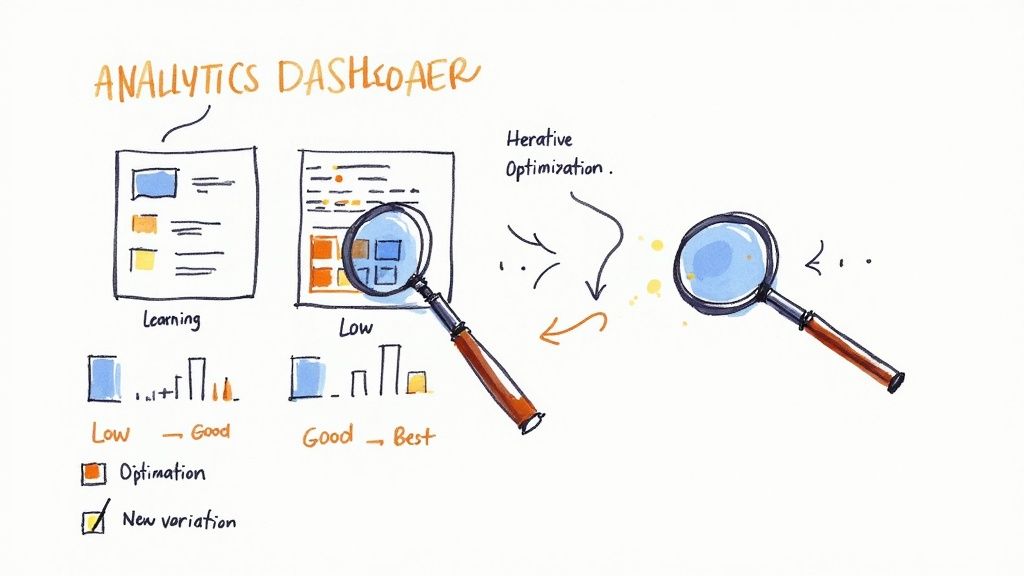
Inside the asset report, Google gives each headline and description a performance label after it gets enough data—usually about 5,000 impressions at the top of the search results over 30 days. Getting a handle on these labels is fundamental to improving your ads over time.
Here's a quick guide to what those labels mean and what you should do about them.
Interpreting RSA Asset Performance Labels
| Performance Label | What It Means | Recommended Action |
|---|---|---|
| Learning | The system is still testing this asset and doesn't have enough data to make a call. | Hold tight. Don't make any changes just yet—let the algorithm run its course. |
| Low | This asset isn't performing as well as others in the same ad. | Swap it out. This is a clear signal to replace this copy with a new idea. |
| Good | This asset is a solid, consistent performer. | Keep it. This is a reliable part of your ad's success, so let it continue to run. |
| Best | This is one of your all-star assets that drives the best results. | Learn from it. Figure out why it works so well and use that insight to create new assets. |
Simply put, your optimization process should be a rinse-and-repeat cycle.
Find everything labeled 'Low,' cut it, and replace it with fresh creative inspired by your 'Best' performers. This simple, iterative loop is how you turn good RSAs into great ones.
Troubleshooting Common Performance Issues
Sometimes, the data doesn't seem to add up. For example, you might have an "Excellent" Ad Strength score but your conversion numbers are in the gutter. What gives? Remember, Ad Strength is just a grade on how well you've followed best practices; it doesn't guarantee performance. If conversions are suffering, the problem is more likely with your core messaging or landing page experience, not the ad's structure.
Another common headache is seeing some headlines or descriptions get almost no impressions. This usually happens for two reasons. Either they're too similar to another asset that's already performing better, or they're pinned in a way that’s strangling Google's ability to test them freely.
The payoff for feeding the system a full menu of distinct, high-quality assets can be huge. One agency saw dramatic results after overhauling an underperforming account by expanding from a few assets to 15 headlines and 4 descriptions. This move alone pushed their Ad Strength to 'Excellent' and delivered a 22% decrease in CPC, a 9% increase in CTR, and a 44% jump in conversion rate.
An even simpler A/B test—just unpinning assets—led to a 38% higher conversion rate and an incredible 148% CTR boost. You can explore more about these RSA best practices and see how they can transform your campaigns. By regularly checking your asset report and acting on what it tells you, your RSAs evolve from a static piece of copy into a dynamic, self-improving performance engine.
Answering Your Top Questions About Responsive Search Ads
Even though responsive search ads have been around for a while, they still bring up a lot of good questions. Let's walk through some of the most common ones I hear from advertisers to help you get the most out of your Google Ads campaigns.
How Many Responsive Search Ads Should I Run in One Ad Group?
This is easily the most frequent question. While Google lets you have up to three enabled RSAs in an ad group, its own official guidance recommends sticking to just one.
Why only one? Because if you have a smaller budget or are in a low-volume industry, running multiple RSAs splits your impressions. This starves Google’s machine learning of the data it needs to figure out what works, slowing down optimization to a crawl.
For nearly everyone, the best approach is to build one fantastic RSA with a solid variety of assets. This lets the algorithm learn as quickly as possible and start delivering results. Quality over quantity is the name of the game here.
Should I Obsess Over the "Ad Strength" Score?
It’s easy to get fixated on the Ad Strength score, but you really shouldn't. Think of it as a helpful setup guide, not a final grade on your ad's performance. It’s simply checking boxes: did you provide enough headlines? Are they unique? Did you include keywords?
A perfect "Excellent" Ad Strength score won't magically deliver conversions, just as a "Poor" score doesn't mean your ad is doomed. The metrics that actually run your business—conversion rate, CPA, ROAS—are the only ones that truly matter.
Use Ad Strength as a quick check while you're building the ad. If the score is low, it’s a nudge to add more creative options. Once your campaign is live, your focus should shift completely to the real-world performance data.
How Many Headlines and Descriptions Should I Actually Write?
Google gives you space for 15 headlines and 4 descriptions, but don't feel pressured to fill every single slot. The goal is to give the system enough high-quality, distinct assets to test and combine.
A great starting point is writing 8 to 10 genuinely unique headlines and all 4 descriptions. This gives the algorithm plenty to work with without you having to come up with filler copy just to hit a number. Remember, a dozen strong, varied headlines will always beat fifteen repetitive ones.
What’s the Difference Between RSAs and Dynamic Search Ads?
This is another common mix-up. The core difference comes down to who writes the copy.
-
Responsive Search Ads (RSAs): You are in the driver's seat. You write all the possible headlines and descriptions, and Google’s AI simply assembles them into different combinations.
-
Dynamic Search Ads (DSAs): You don't write the headlines at all. Google takes over, crawling your website's content and generating headlines automatically based on the user's search query.
RSAs offer creative control, which is perfect when you need to run highly targeted, keyword-focused campaigns. DSAs, on the other hand, are built for automation and scale, making them a great fit for businesses with huge product inventories or content-heavy websites.
If you're using Google Ads lead forms to capture new customers, Pushmylead can instantly forward that lead information directly to your email inbox. Stop logging into Google Ads to manually download your leads and get notified the moment a prospect shows interest.