

A solid pay per click strategy isn't just a list of things to do; it's the master plan for your entire Google Ads effort. It's what guides every single decision you make, from the goals you set at the very beginning to how you structure your campaigns. Without one, you're just spending money and hoping for the best. With one, every dollar becomes a smart investment toward real, predictable growth within the Google Ads ecosystem.
Building the Foundation of Your Google Ads Strategy
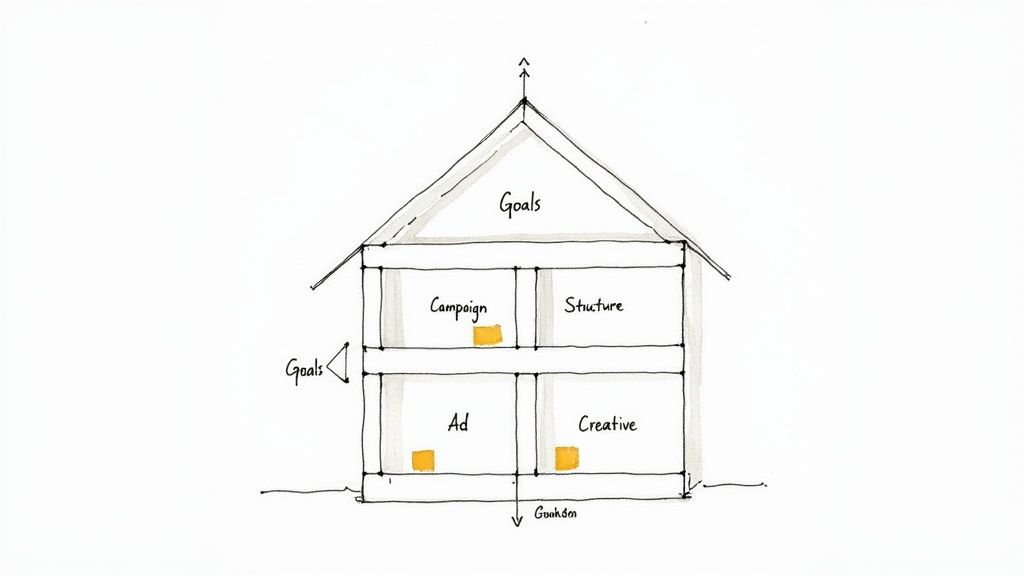
Imagine you're building a house. You wouldn't just show up with a pile of lumber and start nailing boards together, right? You'd need a blueprint. A well-thought-out pay per click strategy is that blueprint for your Google Ads campaigns. It gives you a clear path, keeps things stable, and helps you avoid expensive blunders later on.
Trying to run a Google Ads account without a strategy is like building that house on a patch of sand—it’s just a matter of time before it all comes tumbling down.
The sheer size of the PPC world makes a good plan non-negotiable. The global market is expected to hit a massive $351.5 billion in search ad spend alone by 2025. With the U.S. accounting for about $154.78 billion of that, you can see why having a sharp strategy is the only way to compete on Google. You can discover more insights about the growing PPC market and what it means for businesses.
The Core Components of a Winning Strategy
Just like a good blueprint details the foundation, the framing, and the electrical, a complete PPC strategy is made up of several key parts. Each one builds on the last, creating a powerful, connected system that gets you the results you're after. We’ll walk through each of these pieces one by one, specifically within the Google Ads platform.
Here are the essential pillars we're going to cover:
- Setting Clear Goals: First things first, what does "success" actually mean to you? Is it getting leads, making sales, or just getting your name out there? We'll translate this into Google Ads metrics.
- Designing a Smart Campaign Structure: This is about organizing your account in a way that makes sense, so you can control your budget, stay relevant, and make management easier.
- Mastering Targeting: We'll dive into mixing the right keywords with Google's powerful audiences to get in front of the people most likely to become customers.
- Optimizing Bids and Creative: It's all about using Smart Bidding and writing ads that people actually want to click to get the best possible return on ad spend (ROAS).
- Ensuring a Seamless Conversion Path: The journey doesn't end at the click. We need to make sure the path from your ad to your landing page and through to a conversion is as smooth as possible.
Defining Your Goals and Actionable KPIs
Before you spend a single cent on your PPC strategy, you need to know what you're trying to achieve. Just chasing clicks and impressions is like sailing without a map—sure, you're moving, but are you getting any closer to your destination? Real success in Google Ads isn't about traffic; it's about hitting tangible business outcomes.
This means you have to shift your focus away from those feel-good vanity metrics and onto the numbers that actually move the needle for your business. Every campaign, every ad group, and every keyword needs a clear, measurable job to do. When you have that kind of clarity, you stop wasting money and start making a strategic investment.
Translating Business Objectives into Google Ads KPIs
The real trick is to connect your big-picture business goals to the specific Key Performance Indicators (KPIs) you can track in Google Ads. The KPIs that matter most will depend entirely on your industry and business model. A B2B company and an e-commerce store might both want to grow, but they’ll measure success in completely different ways.
Think about a software-as-a-service (SaaS) company. Their world revolves around generating qualified leads. Their main KPI would probably be Cost Per Acquisition (CPA) for things like a demo request or a free trial signup. They need to know exactly what it costs to get a potential customer into their sales pipeline.
Now, flip over to an e-commerce brand selling shoes. They're all about immediate profitability. For them, the king of all KPIs is Return On Ad Spend (ROAS). For every dollar they put into ads, they need to see several dollars coming back in sales. It's that simple.
A huge mistake I see people make is treating all conversions the same. A "contact us" form fill from a Fortune 500 company is worlds more valuable than a newsletter signup. Your KPIs have to reflect this difference in value—it's how you teach Google's bidding algorithms what's truly important to you.
Using the SMART Framework for PPC Goals
For your goals to be useful, they have to be airtight. The SMART framework is a fantastic tool for this, making sure your objectives are crystal clear and actually doable.
Here’s how you can apply it to your PPC strategy:
- Specific: Don't just say "get more leads." A specific goal is, "Generate 50 qualified leads for our sales team from the new Search campaign."
- Measurable: You have to be able to track it. "Increase sales" is too fuzzy. "Achieve a 4:1 ROAS on our Google Shopping campaign" is a number you can actually measure.
- Achievable: Be realistic. If your CPA is currently $100, trying to hit $10 overnight isn't going to happen. A much better goal is, "Reduce CPA by 15% over the next quarter."
- Relevant: Your PPC goals need to tie directly into what the business is trying to do. If the company's main push is to grab more market share, a relevant goal might be to maximize the number of conversions, even if it means a slightly higher CPA.
- Time-bound: Every goal needs a finish line. "Generate 200 sales from our Performance Max campaign by the end of Q3" creates a sense of urgency and a clear date for checking your results.
By setting SMART goals, you’re not just hoping for success—you're building a roadmap to get there. It gives you a clear benchmark to measure against, so you can make decisions based on data and continuously improve your strategy.
Building Your Google Ads Account: The Blueprint for Success
A well-organized Google Ads account is the secret weapon behind almost every winning PPC strategy. It’s not just about being neat and tidy; a logical structure is the bedrock of control, relevance, and, ultimately, performance.
Think of it like building a house. Your account is the entire property. The campaigns are the different rooms—kitchen, living room, bedroom. Each room has a distinct purpose.
Inside each room, the ad groups are the furniture. The couch and coffee table go in the living room, the oven and fridge in the kitchen. Finally, your keywords and ads are the small details, like the pillows on the couch or the food in the fridge. Everything has its place, making the whole house functional and easy to navigate. This is exactly what you want for your users (and for Google).
This kind of deliberate organization ensures your high-level business goals connect directly to the nitty-gritty details of your campaigns.
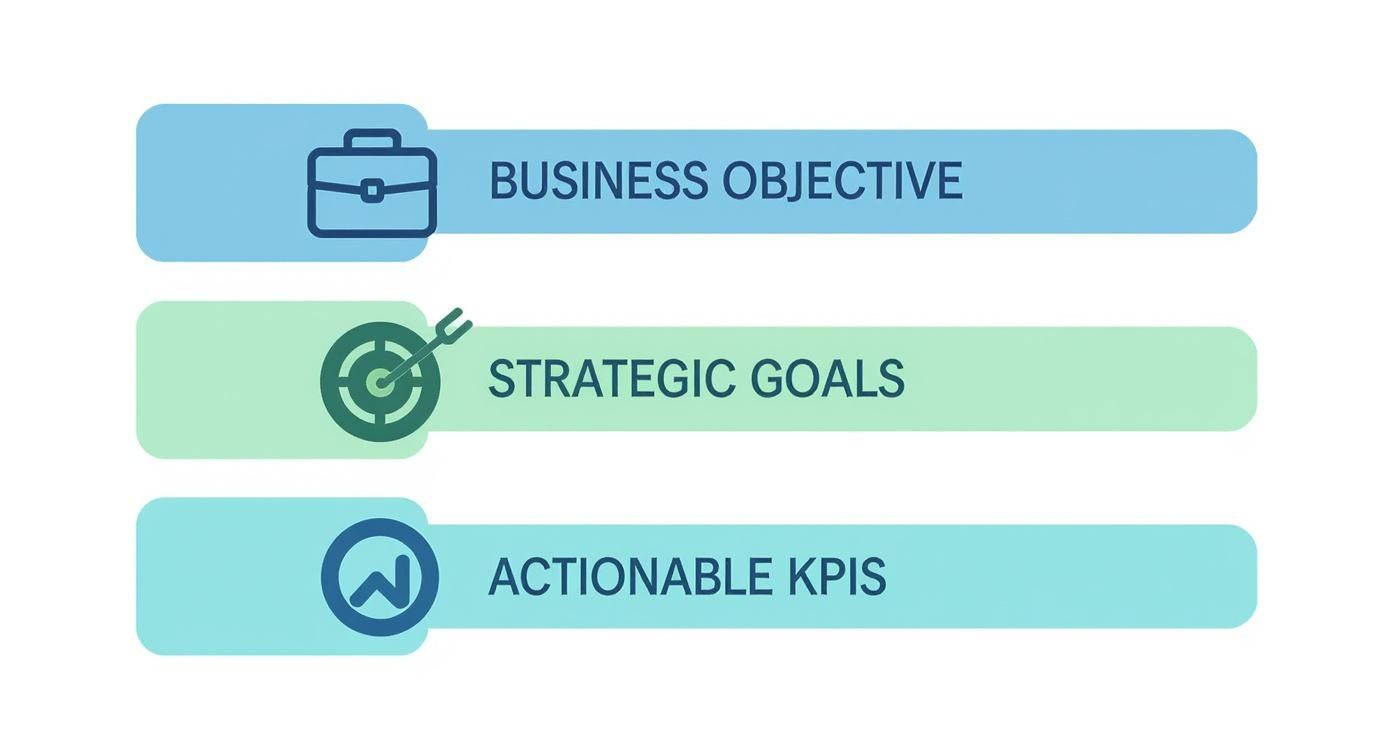
As you can see, every single metric you track should be a clear signal that you’re moving closer to your main business objective.
Structuring Campaigns for Control and Relevance
First things first: how do you decide what your "rooms," or campaigns, should be? This decision should always mirror your business goals and marketing priorities. There's no single right answer, but there are several smart ways to slice it.
Common and effective ways to structure campaigns include:
- By Product or Service Line: This is the go-to for most businesses. If you run an e-commerce store, you’d have separate campaigns for "Men's Running Shoes," "Women's Hiking Boots," and "Kid's Sandals." It’s clean and simple.
- By Geographic Target: If your business serves different cities, states, or countries, location-based campaigns are a must. This lets you customize budgets, ad copy, and offers for local markets.
- By Campaign Type: Google offers various campaign types like Search, Display, Shopping, and the increasingly popular Performance Max (PMax). Structuring by type allows you to allocate budget based on what's performing best. A newer strategy involves pairing a broad PMax campaign with specific Search campaigns to cover all bases.
Breaking your account down this way gives you precise control. If "Men's Running Shoes" is your most profitable category, you can easily push more budget there without messing with your other campaigns.
The Power of Tightly Themed Ad Groups
With your campaigns set, the real work begins at the ad group level—the "furniture" in your rooms. An ad group holds a small cluster of closely related keywords and the ads that show for them.
The golden rule here is to create tightly themed ad groups. This is non-negotiable. It means every keyword within an ad group is so similar that one ad speaks perfectly to all of them.
For example, an ad group for "Men's Trail Running Shoes" should only have keywords like "best men's trail running shoes," "waterproof trail runners for men," and "buy Salomon trail shoes men." It absolutely should not include keywords for "men's road running shoes" or "women's trail shoes."
A messy ad group with dozens of unrelated keywords is a surefire way to kill your Quality Score. Google rewards relevance. When your keyword, ad, and landing page all tell the same story, your costs drop and your ad rank climbs.
This obsession with relevance directly boosts your Quality Score, which is Google’s rating of the quality and relevance of your keywords and ads. A high score is Google's way of saying, "You're giving our users exactly what they want." Your reward? Better ad positions for a lower Cost Per Click (CPC).
The following table breaks down the difference between a lazy, catch-all structure and the kind of granular setup that actually gets results.
Good vs. Bad Google Ads Account Structure
| Attribute | Poor Structure (The 'Catch-All' Approach) | Good Structure (The 'Granular' Approach) |
|---|---|---|
| Keywords | One ad group with 50+ mixed keywords (e.g., running shoes, hiking boots, dress shoes). | Multiple ad groups with 5-15 highly similar keywords each (e.g., one for "men's running shoes," another for "women's hiking boots"). |
| Ad Copy | A single generic ad ("Shop Our Shoes Today!") tries to serve all keywords. | Specific, tailored ads for each theme ("Durable Men's Trail Shoes" or "Comfortable Women's Sandals"). |
| Relevance | Low. The ad for "Shop Shoes" is a poor match for a search like "best waterproof hiking boots." | High. The ad and landing page perfectly match the user's search intent. |
| Quality Score | Low (typically 1-4/10). Google sees a disconnect between the keyword and the ad. | High (typically 7-10/10). Google rewards the strong relevance. |
| Cost Per Click | High. You pay a premium to overcome the low Quality Score. | Low. A high Quality Score earns you a discount on your clicks. |
| Performance | Poor click-through rates, low conversion rates, and wasted ad spend. | High click-through rates, better conversion rates, and a strong Return on Ad Spend (ROAS). |
Ultimately, a granular structure does more than just keep you organized. It makes your ads more compelling, boosts click-through rates, and lays the essential groundwork for a profitable Google Ads machine.
3. Keywords and Audiences: The Heart of Your PPC Strategy
If your campaign structure is the skeleton, then your keywords and audiences are the heart and soul. This is where the magic happens. Getting these two things right is the difference between blindly spending money and connecting with the perfect customer at the exact moment they need you.
Think about it: you're not just buying clicks. You're trying to have a meaningful conversation with a real person who has a real problem you can solve. Keywords and audiences are how you find them.
Reading Minds with Keyword Intent
The first step is getting inside your customer's head. What are they actually typing into that Google search bar? This goes way deeper than just brainstorming a few obvious terms for your business. You have to learn to decode the user intent behind every single search.
Every search query is a clue. It tells you where someone is in their buying journey. We can group these clues into three main categories, and a smart PPC strategy treats each one differently. We cover this in-depth in our guide on how to build a keyword list.
- Informational Intent: These folks are just starting out. They're looking for answers and information. Their searches often start with "how to," "what is," or "best way to." For example, "how to start running."
- Commercial Intent: Now they're getting serious. They're comparing options and figuring out what's best for them. A search might look like, "best running shoes for beginners."
- Transactional Intent: This is the money keyword. They've done their research, made a decision, and have their credit card out. Searches will be specific, using words like "buy," "sale," or a particular product name, like "buy Brooks Ghost 15 size 9."
You absolutely have to match your ad's message to their intent. Trying to hard-sell someone just looking for information is a waste of money. And for the person ready to buy? You need to give them a direct, frictionless path to checkout.
Choosing Your Tools: Keyword Match Types
Once you've got your list of keywords, Google gives you control over how precise the targeting is. These controls are called match types, and they are fundamental to managing your budget effectively.
- Broad Match: This is like casting a wide net. It shows your ad for searches related to your keyword, not just the exact phrase. Google Ads News: Google has heavily improved Broad Match in recent years. Paired with Smart Bidding, it's now a powerful tool for discovering new converting queries you hadn't thought of.
- Phrase Match: A great middle-ground. Your ad shows for searches that include the meaning of your keyword. So, if your keyword is "running shoes for women," your ad could show for a search like "women's trail running shoes." It balances reach with relevance.
- Exact Match: This is your sniper rifle. Your ad will only appear for searches with the exact same meaning or intent. It delivers the most relevant traffic, but your total audience will be much smaller.
Here's a pro-tip that will save you a fortune: master the negative keyword. These are the terms you tell Google not to show your ads for. If you sell high-end running gear, adding words like "cheap," "free," and "used" as negatives is one of the fastest ways to improve your campaign's profitability.
Beyond Keywords: Finding the "Who" with Audiences
Keywords tell you what people are searching for. But a truly modern PPC strategy also focuses on who is doing the searching. This is where audience targeting comes in, and it's a total game-changer.
You can layer audience signals on top of your keyword targeting to find your ideal customer. This is especially vital today, with 52% of all PPC clicks now happening on mobile devices. And with mobile search ads making up 70% of all U.S. search impressions, you can't afford to ignore the user behind the screen. As we see mobile ad spending projected to rocket to $228.1 billion by 2025, using audiences is how you find the most valuable people in that massive market. You can dive deeper into these PPC statistics and trends at Digital Silk.
Here are a few of the most powerful Google Ads audience types you can use:
- In-Market Audiences: These are people Google knows are actively shopping for products or services like yours. It's like having a list of hot leads handed to you.
- Affinity Audiences: This is about long-term interests. Think "marathon runners" or "health and fitness buffs." It's great for building brand awareness with a relevant crowd.
- Remarketing Lists (RLSA): This is your secret weapon. You can target people who have already visited your website. They already know you, so you can show them highly specific ads to bring them back.
- Custom Audiences: Want to get really specific? You can build your own audiences based on the websites they browse, apps they use, or even other search terms they've used.
When you combine the precision of keyword intent with the rich detail of audience signals, your Google Ads campaigns become incredibly powerful. You're no longer just bidding on search terms; you're connecting with the right individuals who are most likely to become your next customers.
Optimizing Bids, Ads, and Landing Pages
Alright, you’ve got a solid campaign structure and your targeting is dialed in. Now comes the fun part—the day-to-day work of turning those settings into actual profit. This is where you get to pull the three main levers that directly control your campaign's performance: your bids, your ads, and your landing pages.
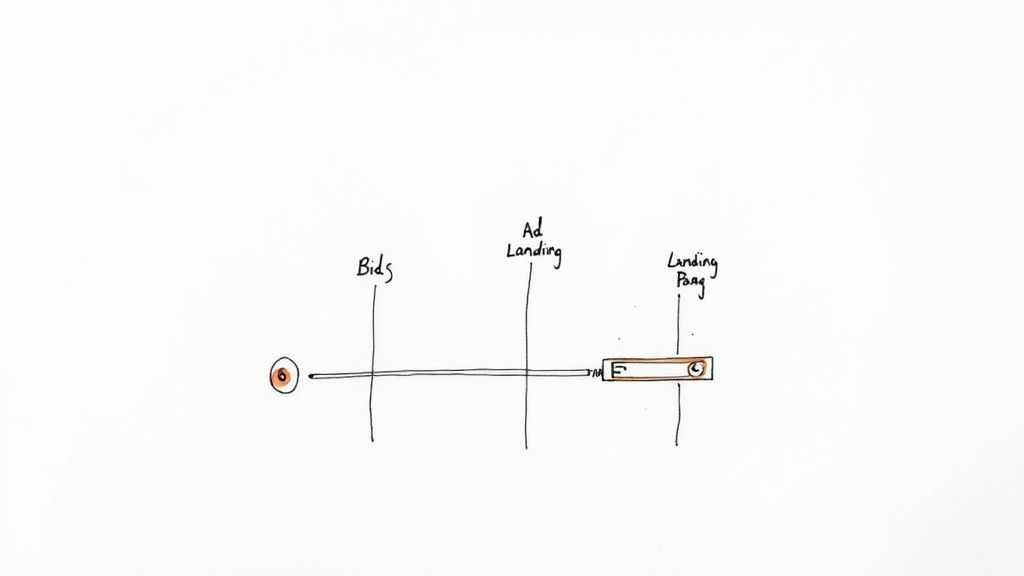
Think of it like a three-legged stool. If your bids are spot-on but your ads are boring, the stool gets wobbly. If your ads are fantastic but your landing page is a confusing mess, the whole thing collapses. To get a strong return on your investment, all three need to be working together perfectly.
Making Sense of Google Ads Bidding
Google Ads gives you a whole menu of bidding options, from completely manual to fully automated. The trick is to pick the right one for the job, depending on your campaign goals and how much data you've collected so far.
Google's Smart Bidding uses machine learning to automatically set your bids to hit a specific goal, like getting conversions or a certain return. It’s like having a supercomputer analyzing thousands of signals in real-time—like the user's device, location, and past behavior—to set the perfect bid for every single auction.
Here are the most common Smart Bidding options:
- Target CPA (Cost Per Acquisition): You tell Google what you’re willing to pay for a conversion, and it tries to get you as many as possible at that average cost. This is perfect for lead generation where every lead is worth roughly the same to your business.
- Target ROAS (Return On Ad Spend): You set a target return for every dollar spent. This is the go-to for e-commerce stores that need to protect their profit margins.
- Maximize Conversions/Conversion Value: These strategies tell Google to get the most conversions or value possible within your budget. This is a great choice when you want to scale up.
Tip: For Smart Bidding to work effectively, you need a healthy amount of conversion data. Google recommends at least 15 conversions in the last 30 days for Target CPA and at least 50 for Target ROAS.
Writing Ads That People Actually Want to Click
Your ad is your digital storefront on the search results page. It's surrounded by competitors, so it has to stand out, clearly state its value, and give someone a great reason to choose you. A killer ad isn't just about clever copy; it’s about being incredibly relevant to what the searcher is looking for. Responsive Search Ads (RSAs) are now the standard in Google Ads, allowing you to provide multiple headlines and descriptions that Google's AI mixes and matches to find the best-performing combinations.
From Click to Conversion: The Landing Page Bridge
Getting the click is only half the battle. Your landing page is where the real magic happens—it’s where you turn a visitor into a customer. To do that, the page has to be a seamless continuation of the promise you made in your ad.
This idea is called message match. If your ad screams "50% Off Running Shoes," your landing page better have that same offer front and center. Any disconnect creates friction and sends people straight for the back button. Following established landing page design best practices is a non-negotiable step to nail this consistency and boost your conversion rates.
Your landing page has one job: get the user to take a specific action. That's it. Strip away everything else that doesn't serve that goal, like distracting navigation menus or links to other pages. A focused page is a high-converting page.
Beyond message match, your landing page needs a crystal-clear value proposition, an easy-to-use design (especially for mobile users), and one big, obvious call-to-action (CTA). Don't be afraid to test everything—headlines, button colors, form fields—to figure out what your audience responds to best.
Turning Your PPC Strategy into a Growth Engine
https://www.youtube.com/embed/LM0TSD5SUdU
A strong pay-per-click strategy is so much more than just another line item on your marketing budget. Think of it as a living, breathing system you're building specifically for growth. It’s definitely not a channel you can just "set and forget." Real, sustainable success comes from a constant cycle of testing, measuring, and tweaking every single part of your campaigns.
This whole journey is about transforming your Google Ads account from a simple advertising tool into a predictable engine for your business. It all starts with setting clear goals and building a logical campaign structure. From there, it's about mastering keyword intent and audience targeting, all while you relentlessly optimize your bids, ads, and landing pages. Every piece works together, creating a powerful, well-oiled machine.
Your Path to PPC Mastery
Ultimately, this is about putting you in the driver's seat. When you apply these principles, you stop just managing ads and start strategically steering a core part of your business's success. You'll have a repeatable framework you can count on to generate leads and sales.
Ready to put these ideas into practice? Use this quick checklist to take a hard look at your own campaigns and find areas for improvement:
- Goal Alignment: Do your KPIs actually map back to your big-picture business objectives?
- Structural Integrity: Are your campaigns and ad groups super-focused and organized by a clear theme?
- Targeting Precision: Are you layering specific audience signals on top of your keyword strategy?
- Optimization Cadence: Do you have a regular, scheduled process for testing ad creative and adjusting bids?
- Conversion Flow: Is the user's journey from your ad, to your landing page, and through to lead capture completely seamless?
For businesses that are serious about scaling up and getting the best possible return on their ad spend, partnering with a top E-commerce PPC agency can bring in the specialized expertise needed to get results faster. By consistently focusing on these strategic pillars, you're not just running ads—you're on your way to achieving true PPC mastery.
Common Questions About PPC Strategy
Even with the best-laid plans, running Google Ads always sparks a few questions. A winning pay per click strategy isn't just about the initial setup; it's about knowing how to handle the common hurdles that pop up along the way. Let's dig into some of the questions I hear most often.
How Much Should I Budget for My Pay Per Click Strategy?
This is the million-dollar question, but there’s no magic number that fits everyone. The best way to figure this out is to work backward from what you want to achieve.
Start by defining your target Cost Per Acquisition (CPA). In plain English, how much are you willing to pay to get a new lead or customer? Then, look at your landing page's conversion rate. For example, if you're willing to pay $50 for a new customer and your landing page converts 5% of its visitors, you can afford to bid up to $2.50 per click. The math is simple: $50 CPA * 5% conversion rate = $2.50 max CPC.
Begin with a test budget you're okay with losing. Seriously. Put that initial cash into your most promising, highest-intent campaigns, and only start spending more once you have real data showing it's working.
What Is a Good Quality Score and How Do I Improve It?
Think of Quality Score as Google's report card for your ads. It’s a score from 1 to 10 that grades how relevant your keywords, ads, and landing pages are to someone's search. Anything 7/10 or above is solid. A high score is your ticket to lower ad costs and better ad positions.
Google’s Quality Score is basically a measure of user experience. A high score tells Google, "Hey, this advertiser gives my users exactly what they're looking for." In return, Google rewards you with a prime spot in the search results.
Boosting your score is all about nailing these three things:
- Ad Relevance: Make sure your ad copy closely matches the keywords in its ad group. If someone searches for "blue running shoes," your ad should talk about blue running shoes.
- Expected Click-Through Rate (CTR): Your ad needs to grab attention. Write something compelling that makes people want to click on it over the others.
- Landing Page Experience: The journey can't end at the ad. Your landing page has to deliver on the ad's promise and make it incredibly easy for visitors to do what you want them to do.
How Long Does It Take to See Results from a PPC Strategy?
PPC can drive traffic to your site the minute you launch a campaign, but seeing real, bottom-line results takes a bit of patience. The first week or two is all about gathering data. Google's algorithm is just getting to know your campaign, your audience, and what works. This is often called the "learning phase."
You’ll likely spend the first month tweaking and tuning based on what that initial data tells you. Realistically, it often takes a full 90 days to dial in a new pay per click strategy. That's enough time to test different ads, adjust your bidding, and get a steady, predictable stream of leads or sales coming in. Remember, Google Ads is a marathon of ongoing improvements, not a sprint.
At Pushmylead, we think your time is better spent closing deals, not downloading CSV files. Our tool zaps new leads from your Google Ads lead forms straight to your inbox in real time. That means you can follow up in minutes, not hours, and turn more of those clicks into paying customers. Start automating your lead delivery today with Pushmylead.